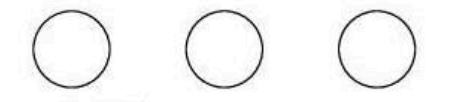
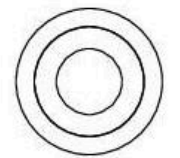
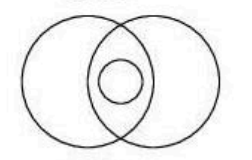
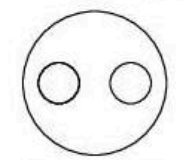
Given below are two statements : one is labelled as Assertion (A) and the other is labelled as Reason (R). Assertion (A) : Drumlins show features opposite to those of Roches Moutonnees. Reason (R) : The stoss side is steep and the lee side is roughened. In the light of the above statements, choose the most appropriate answer from the options given below :
The question requires evaluating two statements, Assertion (A) and Reason (R), concerning the glacial landforms known as drumlins and roches moutonnees.
Evaluation of Assertion (A)
Assertion (A) states that drumlins exhibit features opposite to those of roches moutonnees.
- Drumlins are depositional landforms created by glacial ice. They are typically streamlined, with a blunt, steep end facing the direction of ice flow (the stoss side) and a tapered, gentler end pointing away from the ice flow (the lee side).
- Roches Moutonnees are erosional landforms carved by glacial ice. They are characterized by a smooth, gently sloping stoss side (shaped by abrasion) and a steep, jagged lee side (formed by plucking).
A comparison reveals that the formation processes (deposition vs. erosion) and the typical shapes of the stoss and lee sides are indeed contrasting. Therefore, Assertion (A) is established as correct.
Evaluation of Reason (R)
Reason (R) states: "The stoss side is steep and the lee side is roughened."
Within the framework of this question and its provided answer, this statement is considered factually correct. It highlights specific morphological attributes relevant to glacial features. For example, the stoss end of a drumlin can be steep, and the lee side of a roche moutonnée is characteristically steep and roughened due to glacial plucking.
Analysis of the Relationship Between (A) and (R)
Assertion (A) correctly identifies the opposing characteristics between drumlins and roches moutonnees. Reason (R) presents a descriptive statement about the steepness of the stoss side and the roughness of the lee side.
While both (A) and (R) are deemed correct, Reason (R) does not explain the fundamental reason for the opposition mentioned in (A). The opposition stems from the distinct geological processes involved – deposition for drumlins and erosion for roches moutonnees – and their resultant shaping mechanisms. Reason (R) describes certain features but does not articulate the underlying cause of the contrasting morphology. Consequently, (R) is not the correct explanation of (A).
Final Answer Determination
Based on the analysis, both Assertion (A) and Reason (R) are correct, but Reason (R) does not serve as the correct explanation for Assertion (A). This aligns with Option B.
Similar Questions
Given below are two statements : one is labelled as Assertion (A) and the other is labelled as Reason (R).
Assertion (A) : Many natural disasters are caused by the volcanic activity occurring in the island arc systems.
Reason (R) : The fissure type volcanism causes the erupted lava to spread over wide areas.
In the light of the above statements, choose the most appropriate answer from the options given below :
Given below are two statements : one is labelled as Assertion (A) and the other is labelled as Reason (R).
Assertion (A) : Gypsum has lower density than anhydrite.
Reason (R) : Hydrated minerals tend to expand many times the original volume of the anhydrous minerals.
In the light of the above statements, choose the most appropriate answer from the options given below :
Given below are two statements : one is labelled as Assertion (A) and the other is labelled as Reason (R).
Assertion (A) : In a hand specimen quartz can be easily distinguished from orthoclase.
Reason (R) : Orthoclase has lower refractive index than quartz.
In the light of the above statements, choose the most appropriate answer from the options given below :
Given below are two statements : one is labelled as Assertion (A) and the other is labelled as Reason (R).
Assertion (A) : L waves are responsible for majority of the destructive earthquakes.
Reason (R) : They are the surface waves and develope in the immediate vicinity of the epicenter.
In the light of the above statements, choose the most appropriate answer from the options given below :
Given below are two statements : one is labelled as Assertion (A) and the other is labelled as Reason (R).
Assertion (A) : All continents were united together in the past.
Reason (R) : The Gangamopteris and Glossopteris flora have been found on all the southern continents.
In the light of the above statements, choose the most appropriate answer from the options given below :
Given below are two statements : one is labelled as Assertion (A) and the other is labelled as Reason (R).
Assertion (A) : A dip-slip fault can be a wrench fault.
Reason (R) : Along a dip fault, the net slip can be equal to strike-slip, dip-slip or oblique-slip.
In the light of the above statements, choose the most appropriate answer from the options given below :
Given below are two statements : one is labelled as Assertion (A) and the other is labelled as Reason (R).
Assertion (A) : Chronostratigraphy is concerned with the mutual time relationship of strata.
Reason (R) : Formation, member and bed are units of chronostratigraphy.
In the light of the above statements, choose the most appropriate answer from the options given below :
Given below are two statements : one is labelled as Assertion (A) and the other is labelled as Reason (R).
Assertion (A) : The angle between any two faces of a crystal is termed as interfacial angle.
Reason (R) : The interfacial angles of corresponding faces of different crystals are constant if they have same chemical composition and measurements are taken at same temperature.
In the light of the above statements, choose the most appropriate answer from the options given below :
Match List - I with List - II.
List - I
Crystal SystemList - II
CharacteristicsA. Monoclinic I. 4 triads B. Tetragonal II. 3 diads C. Orthorhombic III. 1 tetrad D. Cubic IV. 1 diad Choose the correct answer from the options given below :
Match List - I with List - II.
List - I
Twin typeList - II
MineralA. Geneculated twins I. Staurolite B. Cruviform twins II. Rutile C. Butterfly twins III. Gypsum D. Arrow head twins IV. Calcite Choose the correct answer from the options given below :
Important Questions from Mixed Topic (CUET PG)
- Kalpsutra, the illustrated canonical text is from:-
- The Harappan city almost exclusively devoted to craft production was-:
- Mohandas Karamchand Gandhi launched quit India movement after the failure of:-
- The "Objectives Resolution" was introduced in constituent assembly by:-
- Who among the following was not a member of the constituent assembly:-