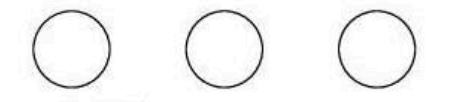
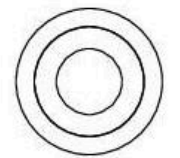
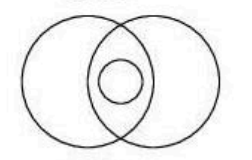
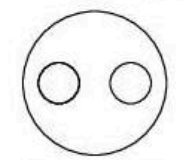
Assertion (A) : The single thread tensile strength tester works on pendulum lever principle.
Reason (R) : The force acting on the specimen is directly proportional to the sine of the angle through which the pendulum is lifted from its vertical rest position.
In the light of the above statements, choose the most appropriate answer from the options given below :
Analyzing Tensile Strength Tester: Pendulum Lever Principle
This question involves evaluating two statements about the working principle of a single thread tensile strength tester.
Assertion (A) Analysis
Assertion (A) states that the single thread tensile strength tester works on the pendulum lever principle. Many tensile strength testers, particularly those used for materials like paper (e.g., Elmendorf testers), utilize a pendulum mechanism. The breaking of the specimen causes a change in the pendulum's position, which is then measured to determine the force. Therefore, this statement is correct.
Reason (R) Analysis
Reason (R) states that the force acting on the specimen is directly proportional to the sine of the angle through which the pendulum is lifted from its vertical rest position. In a pendulum system designed for force measurement, the torque exerted by the pendulum is often related to the angle $\theta$ from the vertical. For instance, the restoring torque due to gravity is proportional to $\sin(\theta)$. When this torque is balanced by the force applied to break the specimen, the force measured is indeed linked to the sine of the pendulum's angular displacement. This physical relationship is fundamental to how the pendulum lever principle is applied.
Evaluating the Explanation
The pendulum lever principle relies on measuring the force indirectly through the motion of a pendulum. Reason (R) precisely describes the physical relationship between the applied force (which causes the pendulum to move) and the resulting angular displacement ($\sin(\theta)$). This explains *how* the pendulum lever principle operates in this testing apparatus.
Conclusion
Since both Assertion (A) and Reason (R) are factually correct, and Reason (R) provides the underlying physical explanation for the operation described in Assertion (A), they are both correct and (R) is the correct explanation of (A).
Similar Questions
- The major constituent of cotton fibre is _________.
- The acrylic fibre is manufactured by wet spinning process rather than melt spinning process due to ________ of acrylic polymer.
- The Scanning Electron Microscopy (SEM) gives the ________ features of material.
- The glass transition temperature of polyethylene polymer is low in comparison with that of polypropylene fibre because of ________ molecular chain of polyethylene.
- The polyester (PET) fibre spun by high speed spinning technology shows high crystalline orientation but low birefringence due to ________.
- The main objective of drawing of synthetic fibre is to impart the molecular ________ along the fibre axis.
- On mercerization, the strength and moisture absorption capacity of cotton fibre increases. The reason for increase is ________.
- The glass marbles are subjected to melting process at the temperature of ________ before feeding to spinneret for its spinning.
- The primary purpose of ginning process is to ________.
- The chute feed system is beneficial over the formation of lap due to ________.
Important Questions from Miscellaneous
- Which of the following relationships is/are not true?
(A). Most probable velocity = $\sqrt{\frac{2RT}{M}}$
(B). PV = $\frac{3}{2}kT$
(C). Compressibility factor Z = $\frac{pV}{nRT}$
(D). Average kinetic energy of gas = $\frac{1}{2}kT$
Choose the correct answer from the options given below - Match List-I with List-II
List-I List-II Electronic Configuration First Ionisation energy (kJ mol$^{-1}$) (A). ns$^2$ (I). 2100 (B). ns$^2$np$^1$ (II). 1400 (C). ns$^2$np$^3$ (III). 800 (D). ns$^2$np$^6$ (IV). 900
Choose the correct answer from the options given below: - The shielding constant of a 2p electron (calculated using Slater's rules) is
- Match List-I with List-II
List-I List-II Spectroscopy Property (A). Raman (I). Polarizability (B). FTIR (II). Dipole Moment (C). UV-Visible (III). Absorbance (D). NMR (IV). Spin
Choose the correct answer from the options given below: - The structure of protein comprises of:
(A). Primary structure of protein is associated with amino acids
(B). Secondary structure of protein is associated to peptides
(C). Tertiary structure of protein is associated with polypeptide chains
(D). Quaternary structure of protein is associated with polypeptide chains
Choose the correct answer from the options given below: