
Understanding Living Fossil Pairs
A "living fossil" is an organism that has remained morphologically unchanged over long geological timescales, appearing similar to its fossilized ancestors.
Analyzing the Living Fossil Pairs
The question asks to identify the pair where one organism is a brachiopod and the other is a mollusc, with both being considered living fossils.
- Option 1: Lingula, Nautilus
- Lingula is a genus of brachiopods, known for its ancient lineage and minimal evolutionary change. It is a classic example of a living fossil.
- Nautilus is a cephalopod mollusc, also considered a living fossil due to its primitive shell structure and ancient ancestry, distinct from other modern cephalopods like squid and octopus.
- This pair correctly represents a brachiopod and a mollusc that are both living fossils.
- Option 2: Ginkgo, Metasequoia
- Ginkgo biloba (a plant) and Metasequoia glyptostroboides (a plant) are both famous living fossils, but they belong to the plant kingdom, not brachiopods and molluscs.
- Option 3: Syntexis, Notiothauma
- Both Syntexis (possibly referring to a brachiopod genus) and Notiothauma are typically classified as brachiopods. This is not a brachiopod-mollusc pair.
- Option 4: Coelacanths, Sikhotealinia
- Coelacanths are lobe-finned fish. Sikhotealinia is an insect. This pair does not represent brachiopods or molluscs.
Conclusion on Brachiopod-Mollusc Pair
Based on the analysis, Lingula (brachiopod) and Nautilus (mollusc) is the correct brachiopod-mollusc pair of living fossils.
Important Questions from Paleobiology (Taxonomy, Morphology of Invertebrates)
- Which of the following is/are diagnostic morphological feature(s) of brachiopods?
Based on the three statements given below, choose the CORRECT option.
Statement I: Echinoids have water vascular system.
Statement II: Delthyrium and pedicle foramen are found in the brachial valve of brachiopods.
Statement III: Cardinal teeth, adductor muscles and chondrophore are found in bivalves.- Match the following invertebrate genera in Group I with their corresponding Class/Phylum in Group II:
Group I Group II P. Mytilus 1. Brachiopoda Q. Planorbis 2. Cephalopoda R. Productus 3. Gastropoda S. Acanthoceras 4. Pelecypoda - Match the features (Group I) with the corresponding invertebrate genera (Group II).
Group I Group II P. Cardinal Fossula 1. Calymene Q. Chrondrophore 2. Rhynchonella R. Lophophore 3. Zaphrentis S. Glabella 4. Mya Match the following patterns (listed in Group I) with their appropriate Cephalopod sutures (listed in Group II). Arrow gives the direction of aperture.
Group I Group II P. 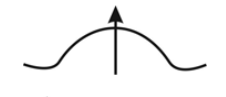
1. Ceratitic Q. 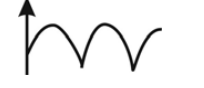
2. Nautilitic R. 
3. Goniatitic S. 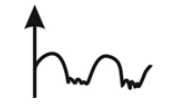
4. Orthoceratitic


