
From a point on the ground, the angles of elevation of the top and the bottom of a flag that is mounted on an 18 m high pole are respectively 60° and 30°. The height of the flag is:
36 m
The correct answer is Option 1 i.e. 36 m.
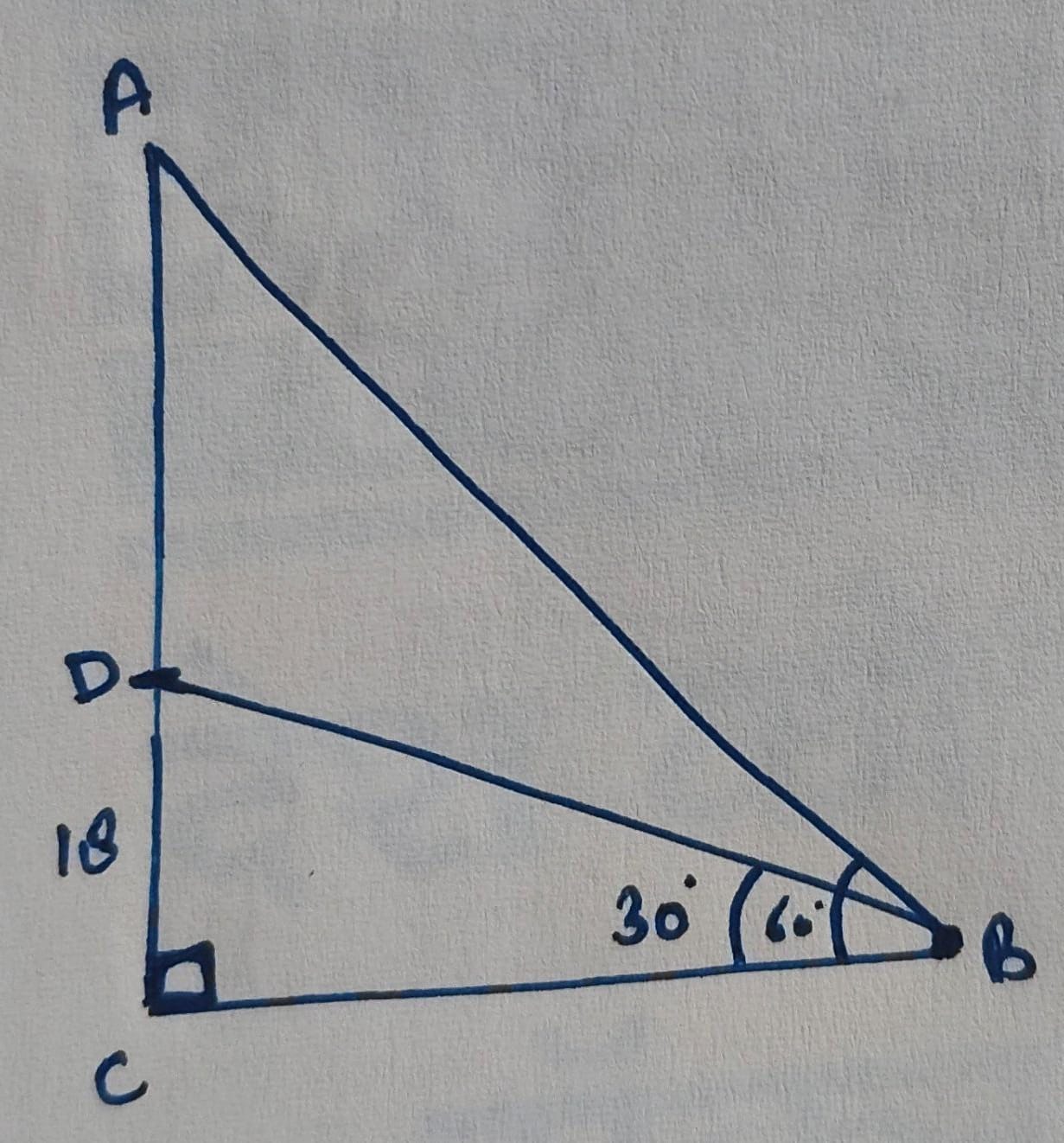
In △DCB,
tan 30° = \(DC \over BC\)
⇒ \(1\over {\sqrt3}\) = \(18 \over BC\)
⇒ BC = 18\(\sqrt3\) m
In △ABC,
tan 60° = \(AC \over BC\)
⇒ \(\sqrt3\) = \((AD+18) \over {18\sqrt3}\)
⇒ AD + 18 = 18 × 3
⇒ AD + 18 = 54
⇒ AD = 36 m
Similar Questions
- If $3\cos^2 x - 2\sin^2 x = -0.75$ and $0^\circ \le x \le 90^\circ$, then $x = ?$
As the angle increases beyond 45 degrees, what happens to the tangent value?
- If ABCD is a Cyclic Quadrilateral, then the value of $\cos^2 A - \cos^2 B - \cos^2 C + \cos^2 D$ is:
- $$ \frac{\sin 30^\circ}{1 + \cos 30^\circ} + \frac{1 + \cos 30^\circ}{\sin 30^\circ} = ? $$
Simplify: (1 - sec2θ)(1 - sinθ)(1 + sinθ)(1 + cot2θ)
If θ is an acute angle, find the denominator D when,
(cotθ - cosecθ)2 = \((1 - cosθ)\over D\)
If sec4A = cosec(3A - 50°), where 4A and 3A are acute angles, find the value of cosec(A + 25°).
If \(\sin \theta = \frac{3}{5}\), find \(\cos \theta\).
- Simplify: \(\frac{\sin A}{1-\cos A} + \frac{1-\cos A}{\sin A}\)
\(cos45° \over{tan30°+ cot60°}\) is equal to:
Important Questions from Trigonometry
- Simplify: $(\cos^4 A - \sin^4 A + 1) \cosec^2 A$
- If $\frac{\sin\alpha + \cos\alpha}{\sin\alpha - \cos\alpha} = 3$, then the value of $\sin^2\alpha$ is:
- Find the value of $\sin (90 - x) \cos (180 - (x - y)) + \cos (90 - x) \sin (180 – (y – x))$ .
- If $X = \frac{(1+\cos\theta)(2-2\cos\theta)}{(2+2\sin\theta)(1 - \sin\theta)}$, then the value of $X + \frac{1}{X} + 2$ is:
- Find the value of $\frac{(\sec^4A-\sec^2A)}{(\cot^2A + \cot^4A)} \times \frac{(\cosec^4A-\cosec^2A)}{(\tan^2A + \tan^4A)} + \cot^2A$.



