
Algebraic Simplification: Finding the Relation Between p and q
We are given the equation $(\frac{p}{q})^{\frac{p}{q}} = p^{(\frac{p}{q}-1)}$ where $p$ and $q$ are positive integers and $\frac{p}{q} \neq 1$. We need to find the relationship between $p$ and $q$. Let's simplify the equation using logarithms.
Step 1: Apply Natural Logarithm
Take the natural logarithm (ln) of both sides of the equation:
$\ln\left((\frac{p}{q})^{\frac{p}{q}}\right) = \ln\left(p^{(\frac{p}{q}-1)}\right)$Step 2: Use Logarithm Properties
Apply the power rule of logarithms, $\ln(a^b) = b \ln(a)$, to both sides:
$\frac{p}{q} \ln(\frac{p}{q}) = (\frac{p}{q}-1) \ln(p)$Now, apply the quotient rule of logarithms, $\ln(\frac{a}{b}) = \ln(a) - \ln(b)$, to the left side:
$\frac{p}{q} (\ln(p) - \ln(q)) = (\frac{p}{q}-1) \ln(p)$Step 3: Simplify the Equation
Distribute the terms:
$\frac{p}{q} \ln(p) - \frac{p}{q} \ln(q) = \frac{p}{q} \ln(p) - \ln(p)$Subtract $\frac{p}{q} \ln(p)$ from both sides:
$- \frac{p}{q} \ln(q) = - \ln(p)$Multiply both sides by -1:
$\frac{p}{q} \ln(q) = \ln(p)$Step 4: Rearrange and Apply Logarithm Properties
Multiply both sides by $q$:
$p \ln(q) = q \ln(p)$Use the power rule of logarithms ($b \ln(a) = \ln(a^b)$) in reverse:
$\ln(q^p) = \ln(p^q)$Step 5: Determine the Final Relation
Since the natural logarithm function is one-to-one, if $\ln(x) = \ln(y)$, then $x=y$. Therefore:
$q^p = p^q$This relationship matches Option 1.
Important Questions from Powers and Exponents
- The digit in the unit's place of the product $3^{999} \times 7^{1000}$ is __________.
- Which one of the following numbers is exactly divisible by $(11^{13} +1)$?
Consider the following functions for non-zero positive integers, $p$ and $q$.
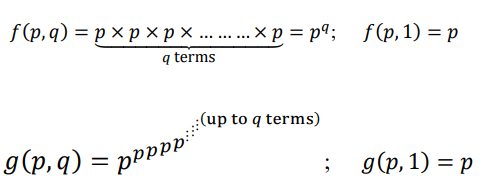
Which one of the following options is correct based on the above?- What is the value of x when $81 \times \left(\frac{16}{25}\right)^{x+2} \div \left(\frac{3}{5}\right)^{2x+4} = 144$?
- What is the value of $\left(\frac{3^{81}}{27^4}\right)^{1/3}$?


