
Five cubes of identical size and another smaller cube are assembled as shown in Figure A. If viewed from direction X, the planar image of the assembly appears as Figure B. 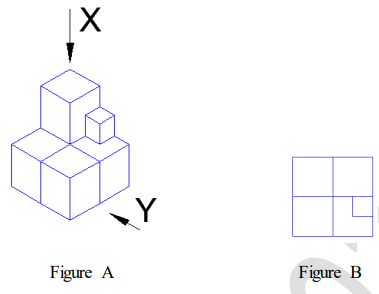
If viewed from direction Y, the planar image of the assembly (Figure A) will appear as

To solve this spatial aptitude question, we need to determine the planar image viewed from direction Y based on Figure A.
1. **Understanding the configuration in Figure A:**
- There are five identical cubes and one smaller cube.
- The cubes are stacked in a way that if viewed from direction X, the configuration forms an L-shaped figure as shown in Figure B.
2. **Analyzing the view from direction Y:**
- To visualize the assembly from direction Y, picture looking at the arrangement from the left side of Figure A.
- The taller stack with one large cube beneath the smaller cube will appear as a vertical stack.
- The three remaining large cubes create a 2x2 base viewed from this side.
3. **Choosing the correct option based on the described perspective:**
- The view from direction Y should show a vertical stack of two cubes and a 2x2 base made by the four larger cubes.
- Upon examining the given options, we find that the correct planar image is option A.
The view from direction Y will appear as shown in the image above. This matches the description and correctly represents the spatial structure from the given perspective.
**Conclusion:** Option A is the correct representation of the planar image when viewing the assembly from direction Y.
Important Questions from 2D 3D Pattern Visualization
Three different views of a dice are shown in the figure below.
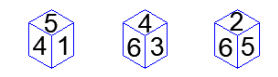
The piece of paper that can be folded to make this dice is
- Visualize two identical right circular cones such that one is inverted over the other and they share a common circular base. If a cutting plane passes through the vertices of the assembled cones, what shape does the outer boundary of the resulting cross-section make?
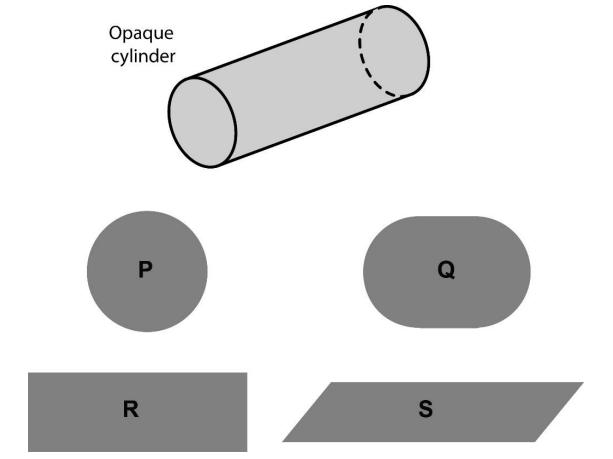
An opaque cylinder (shown below) is suspended in the path of a parallel beam of light, such that its shadow is cast on a screen oriented perpendicular to the direction of the light beam. The cylinder can be reoriented in any direction within the light beam. Under these conditions, which one of the shadows P, Q, R, and S is NOT possible?
A palindrome is a word that reads the same forwards and backwards. In a game of words, a player has the following two plates painted with letters.
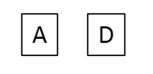
From the additional plates given in the options, which one of the combinations of additional plates would allow the player to construct a five-letter palindrome. The player should use all the five plates exactly once. The plates can be rotated in their plane.
The figure shows a grid formed by a collection of unit squares. The unshaded unit square in the grid represents a hole.
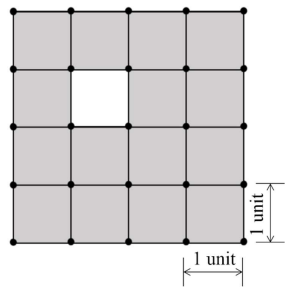
What is the maximum number of squares without a "hole in the interior" that can be formed within the 4 × 4 grid using the unit squares as building blocks?


