A block with a trapezoidal cross-section is placed over a block with rectangular cross section as shown above.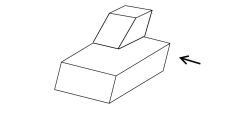
Which one of the following is the correct drawing of the view of the 3D object as viewed in the direction indicated by an arrow in the above figure?

To solve this spatial aptitude problem, we must determine the correct view of the 3D object as seen from the direction indicated by the arrow.
- The given 3D object consists of two blocks:
- A trapezoidal block placed on top.
- A rectangular block on the bottom.
- The view direction is indicated by an arrow pointing towards the object. This means we are observing from the right side of the figure.
- When viewed from the right:
- The trapezoidal block will appear as a rectangle because we are seeing the slanted portion directly from the side.
- The rectangular block underneath will also appear as a rectangle. Its longer side will be visible from this direction.
- Among the options provided, we are looking for an image showing:
- A smaller rectangle on top representing the trapezoidal block (which appears as a rectangle from this view).
- A larger rectangle below representing the base rectangular block.
- Reviewing the options, the correct answer matches the above description of the view. It is shown below:
Therefore, the correct option is the 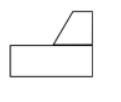 that shows two rectangles, a smaller one on top of a larger one, as seen from the indicated direction.
Important Questions from 2D 3D Pattern Visualization
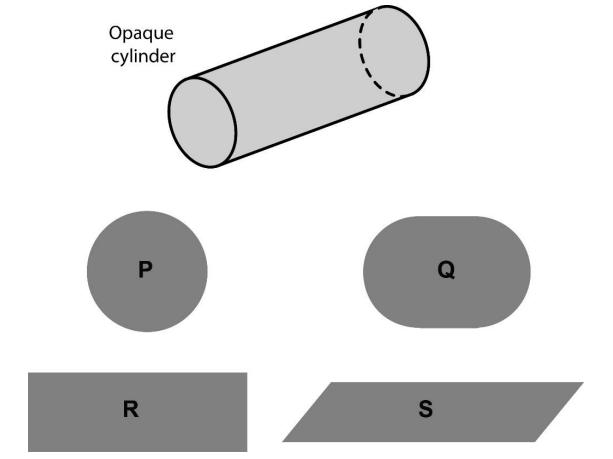
An opaque cylinder (shown below) is suspended in the path of a parallel beam of light, such that its shadow is cast on a screen oriented perpendicular to the direction of the light beam. The cylinder can be reoriented in any direction within the light beam. Under these conditions, which one of the shadows P, Q, R, and S is NOT possible?
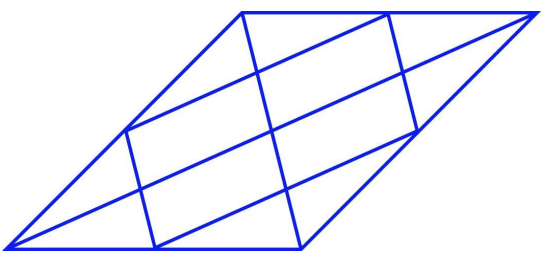
How many triangles are present in the given figure?
The figure shows a grid formed by a collection of unit squares. The unshaded unit square in the grid represents a hole.
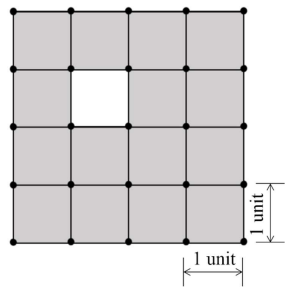
What is the maximum number of squares without a "hole in the interior" that can be formed within the 4 × 4 grid using the unit squares as building blocks?A palindrome is a word that reads the same forwards and backwards. In a game of words, a player has the following two plates painted with letters.
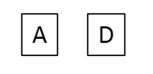
From the additional plates given in the options, which one of the combinations of additional plates would allow the player to construct a five-letter palindrome. The player should use all the five plates exactly once. The plates can be rotated in their plane.
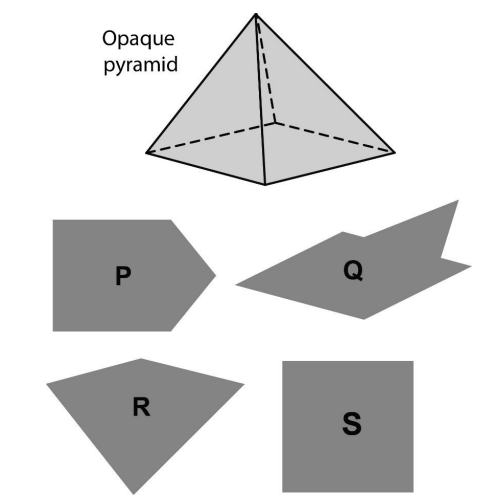
An opaque pyramid (shown below), with a square base and isosceles faces, is suspended in the path of a parallel beam of light, such that its shadow is cast on a screen oriented perpendicular to the direction of the light beam. The pyramid can be reoriented in any direction within the light beam. Under these conditions, which one of the shadows P, Q, R, and S is NOT possible?