
An opaque cylinder (shown below) is suspended in the path of a parallel beam of light, such that its shadow is cast on a screen oriented perpendicular to the direction of the light beam. The cylinder can be reoriented in any direction within the light beam. Under these conditions, which one of the shadows P, Q, R, and S is NOT possible?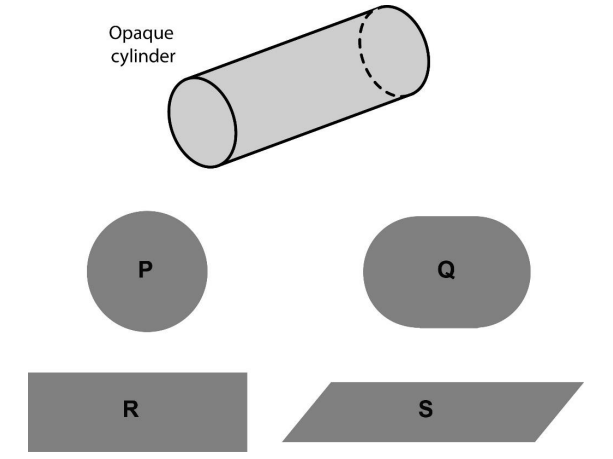
To solve this problem, we need to determine which shadow shape is not possible for an opaque cylinder suspended in a parallel beam of light.
- When the cylinder is oriented with its circular face perpendicular to the beam of light, the shadow will be a circle. This corresponds to shadow P.
- If the cylinder is oriented with its curved face parallel to the light beam, the shadow will be a rectangle. This is represented by shadow R.
- If the cylinder is oriented at an angle to the beam of light, the shadow will be an ellipse. This corresponds to shadow Q.
- Shadow S has a shape like a parallelogram. A cylinder, being a symmetrical object with circular tops, cannot cast a shadow in the form of a parallelogram. This shape is not possible regardless of the cylinder's orientation.
Thus, the shadow shape S is not possible for the given configuration. The cylinder, due to its geometric properties, cannot cast a parallelogram shadow.
Important Questions from 2D 3D Pattern Visualization
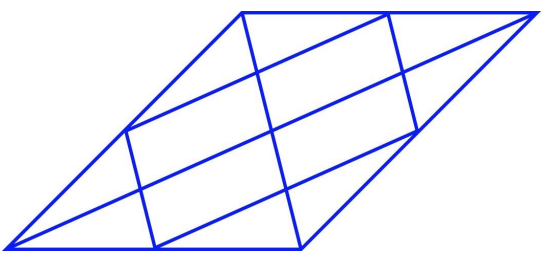
How many triangles are present in the given figure?
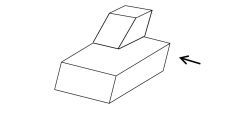
A block with a trapezoidal cross-section is placed over a block with rectangular cross section as shown above.
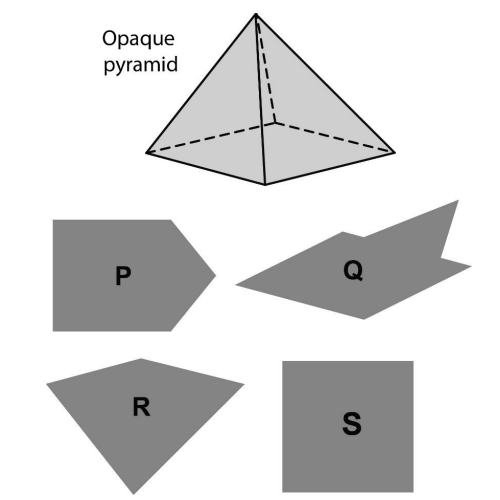
Which one of the following is the correct drawing of the view of the 3D object as viewed in the direction indicated by an arrow in the above figure?An opaque pyramid (shown below), with a square base and isosceles faces, is suspended in the path of a parallel beam of light, such that its shadow is cast on a screen oriented perpendicular to the direction of the light beam. The pyramid can be reoriented in any direction within the light beam. Under these conditions, which one of the shadows P, Q, R, and S is NOT possible?
Five cubes of identical size and another smaller cube are assembled as shown in Figure A. If viewed from direction X, the planar image of the assembly appears as Figure B.
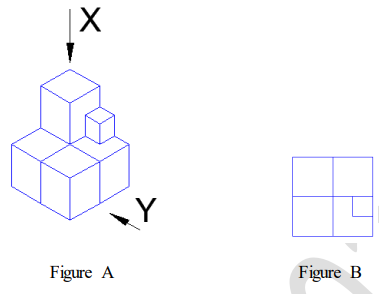
If viewed from direction Y, the planar image of the assembly (Figure A) will appear asThree different views of a dice are shown in the figure below.
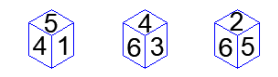
The piece of paper that can be folded to make this dice is


