
Three different views of a dice are shown in the figure below. The piece of paper that can be folded to make this dice is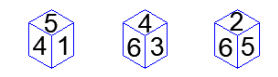
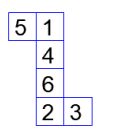
To determine the piece of paper that can be folded to make the dice shown in the images, we need to understand the relationship between the numbers on each face of the dice.
Let's analyze the different views of the dice:
- In the first view, faces with numbers 5, 4, and 1 are visible.
- In the second view, faces with numbers 4, 6, and 3 are visible.
- In the third view, faces with numbers 2, 6, and 5 are visible.
Now, we apply the rule: Two opposite faces of a dice cannot be adjacent in the views shown.
From the above views, we can conclude:
- Face 5 is adjacent to 4 and 1, but never opposite to them.
- Face 6 is adjacent to 4 and 3, indicating that 6 is opposite to 1 (since 1 is not visible in the second view).
- Face 2 is opposite to 4 (since 4 is not visible in the third view where 2 is seen).
Based on these observations, we identify the correct paper cutout for the dice from the given options. The cutout should have opposite faces not adjacent to each other:
Let's view the options given (please see images provided in the original question for visual reference):
This option shows arrangement where:
- 1 is opposite 6
- 2 is opposite 4
- 3 is opposite 5
This arrangement matches the conditions deduced from the views of the dice. Thus, the correct answer is:
Therefore, the piece of paper that can be folded to make this dice is the one indicated in the correct answer image above.
Important Questions from 2D 3D Pattern Visualization
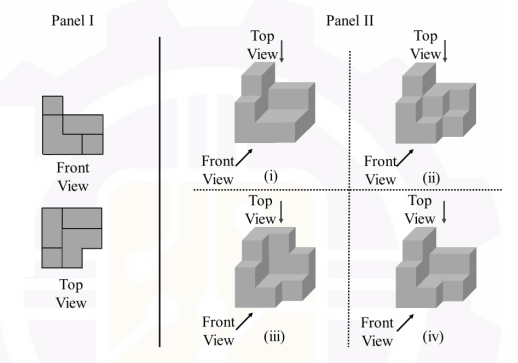
In Panel I of the figure below, the front view and top view of a structure are shown. Which one of the 3D structures shown in Panel II possesses the views shown in Panel I?
- Visualize two identical right circular cones such that one is inverted over the other and they share a common circular base. If a cutting plane passes through the vertices of the assembled cones, what shape does the outer boundary of the resulting cross-section make?
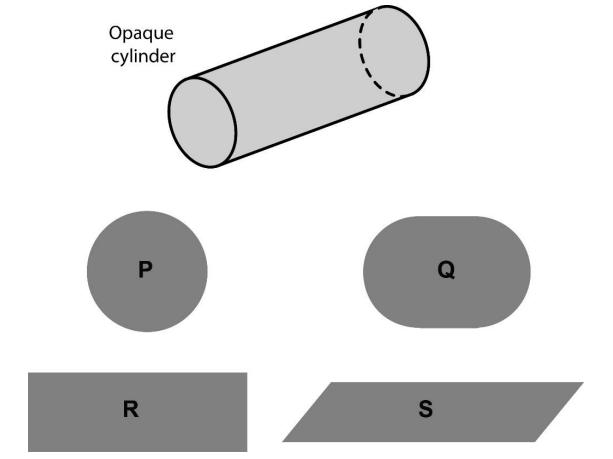
An opaque cylinder (shown below) is suspended in the path of a parallel beam of light, such that its shadow is cast on a screen oriented perpendicular to the direction of the light beam. The cylinder can be reoriented in any direction within the light beam. Under these conditions, which one of the shadows P, Q, R, and S is NOT possible?
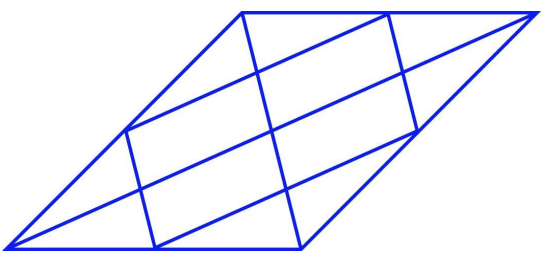
How many triangles are present in the given figure?
The figure shows a grid formed by a collection of unit squares. The unshaded unit square in the grid represents a hole.
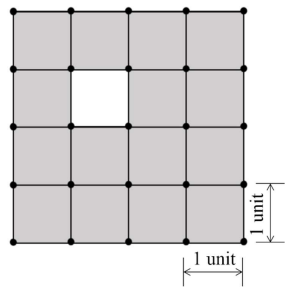
What is the maximum number of squares without a "hole in the interior" that can be formed within the 4 × 4 grid using the unit squares as building blocks?


