
Circle Properties Analysis
We are given two circles:
- Circle 1 ($C_1$): $x^2 + y^2 + 2011x + 2012y + 2013 = 0$
- Circle 2 ($C_2$): $x^2 + y^2 + 2011x + 2012y + 2014 = 0$
The question asks about tangents related to these circles. We first analyze the geometric relationship between $C_1$ and $C_2$.
Identifying Circle Centers
The standard equation of a circle is $x^2 + y^2 + 2gx + 2fy + c = 0$, where the center is $(-g, -f)$.
For both $C_1$ and $C_2$, we have:
- $2g = 2011 \implies g = \frac{2011}{2}$
- $2f = 2012 \implies f = 1006$
The center for both circles is $O = (-\frac{2011}{2}, -1006)$. This means the circles are concentric.
Comparing Circle Radii
The radius squared ($r^2$) is calculated using $r^2 = g^2 + f^2 - c$.
For $C_1$: $r_1^2 = (\frac{2011}{2})^2 + (1006)^2 - 2013$ For $C_2$: $r_2^2 = (\frac{2011}{2})^2 + (1006)^2 - 2014$
Let $K = (\frac{2011}{2})^2 + (1006)^2$. Then $r_1^2 = K - 2013$ and $r_2^2 = K - 2014$. Since $2013 < 2014$, it follows that $-2013 > -2014$. Therefore, $r_1^2 > r_2^2$, which means $r_1 > r_2$.
Determining Common Tangents
The circles share the same center $O$, and the radius $r_2$ of $C_2$ is smaller than the radius $r_1$ of $C_1$ ($r_2 < r_1$). This indicates that Circle $C_2$ lies entirely inside Circle $C_1$.
When one circle is completely inside another, they do not intersect or touch. Consequently, no common tangents can be drawn between them.
Thus, the correct conclusion is that no common tangent can be drawn.
Similar Questions
- PQ is a diameter of a circle whose centre is O. If a point R lies on the circle and $\angle RPO$ is $39^\circ$, then find the measure of $\angle RQP$.
- The points A, B and C lie on a circle with centre O. The $\angle \text{ACB} = 47.5^{\circ}$. What is the $\angle \text{AOB}$ on the minor $\widehat{\text{AB}}$?
- $1^{\circ}$ of latitude is equal to ___ km approximately.
- A wheel makes 1000 revolutions in covering a distance of 154 km. Find the radius (in metre) of the wheel.
- Two intersecting circles are said to be orthogonal if the angle between them is a/an _____.
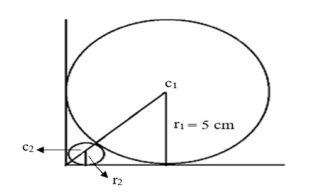
A circle having centre $c_1$, radius $r_1$ = 5 cm is placed against a right angle. Another smaller circle having centre $c_2$, radius $r_2$ is also placed touching the sides of angle and the bigger circle as shown in the figure. Find the radius, $r_2$ in cm, of the smaller circle.
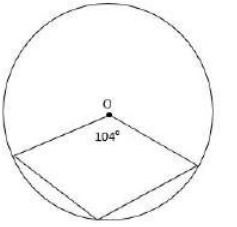
In the given circle with centre O, the obtuse angle at the centre measures $104^\circ$. In the quadrilateral drawn inside the circle, what is the measure of the angle opposite to $\angle\text{O}$? [Figure is not drawn to scale.]
- The chord of contact of tangents drawn from a point on the circle $x^2 + y^2 = a^2$ to the circle $x^2 + y^2 = b^2$ touches the circle $x^2 + y^2 = c^2$ such that $b^m = a^n c^p$, where $m,n,p \in \mathbb{N}$. Find the value of $m + n + p + 10$.
- If a point (1, 2) is translated 2 units through the positive direction of x-axis and then the tangents drawn from that point to the circle $x^2 + y^2 = 9$, find the angle between the tangents.
- The angle of a sector is 30°. If its radius is 42 cm then the length of the arc of the sector is:
Important Questions from Circles
If 3x + y - 5 = 0 is the equation of a chord of the circle x2 + y2 - 25 = 0, then what are the coordinates of the mid-point of the chord ?
What is the area of minor segment ?
What is the area of major segment ?
A straight line x = y + 2 touches the circle 4(x 2+ y 2) = r 2. The value of r is
If the centre of the circle passing through the origin is (3, 4), then the intercepts cut off by the circle on x-axis and y-axis respectively are



