
Examine the first set of figures in Image X. There is a particular relationship between the first and second figures. Using the same connection, select the missing figure from Image Y's options for the second pair. Image X: Image Y: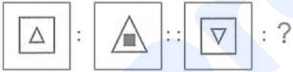
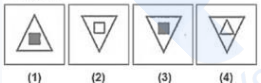
3
In the first pair, a small triangle sits inside a square. In the second figure the inner shape (triangle) becomes the large outer shape, and the outer shape (square) becomes a small filled shape inside it.
Apply the same change to the small inverted triangle in a square: the inverted triangle becomes the large outer shape (still inverted), and the square goes inside it as a small filled square.
This is an inverted triangle with a filled square inside, which is figure 3.
Hence, the answer is 3.
Similar Questions
Select the set in which the numbers are related in the same way as are the numbers of the given sets.
(NOTE: Operations should be performed on the whole numbers, without breaking down the numbers into its constituent digits. E.g. 13 - Operations on 13 such as adding/subtracting /multiplying etc. to 13 can be performed. Breaking down 13 into 1 and 3 and then performing mathematical operations on 1 and 3 is not allowed.)
(6, 4, 8)
(17, 6, 28)
Select the option that is related to the third number in the same way as the second number is related to the first number.
16 : 144 :: 28 : ?
Select the option that is related to the fifth letter-cluster in the same way as the second letter-cluster is related to the first letter-cluster and the fourth letter-cluster is related to the third letter-cluster.
ABILITY : LIBAYTI : : CHRONIC : ORHCCIN : : HEAVILY : ?
Select the related word/letters/numbers from the given alternatives:
381 : 160 :: 478 : ?Select the option that is related to the fifth number in the same way as the second number is related to the first number and the fourth number is related to the third number.
9 ∶ 702 ∶∶ 3 ∶ 18 ∶∶ 6 ∶ ?
Select the set in which the numbers are related in the same way as are the numbers of the following set.
(NOTE: Operations should be performed on the whole numbers, without breaking down the numbers into its constituent digits. E.g. 13 - Operations on 13 such as adding /subtracting /multiplying etc. to 13 can be performed. Breaking down 13 into 1 and 3 and then performing mathematical operations on 1 and 3 is NOT allowed)
(15, 5, 375)
(14, 3, 210)
Select the set in which the numbers are related in the same way as are the numbers of the following sets.
(NOTE: Operations should be performed on the whole numbers, without breaking down the numbers into its constituent digits. E.g. 13 - Operations on 13 such as adding /Subtracting/multiplying etc. to 13 can be performed. Breaking down 13 into 1 and 3 and then performing mathematical operations on 1 and 3 is not allowed)
(6, 7, 98)
(8, 10, 182)
Select the option that is related to the fifth term in the same way as the second term is related to the first term and the fourth term is related to the third term.
32 ∶ 8 ∶∶ 72 ∶ 12 ∶∶ 128 ∶ ?
Select the option that is related to the fifth number in the same way as the second number is related to the first number and the fourth number is related to the third number.
192 ∶ 24 ∶∶ 48 ∶ 12 ∶∶ 432 ∶ ?
Select the option that is related to the fifth term in the same way as the second term is related to the first term and the fourth term Is related to the third term.
160 : 4 :: 250 : 5 :: 360 : ?
Important Questions from Analogy
Select the pair which follows the same pattern as that followed by the two pairs given below. Both pairs follow the same pattern.
HTO : DWK
XHE : TKA- WFJU is related to AINX in a certain way based on the English alphabetical order. In the same way, MRZG is related to QUDJ. To which of the given options is YALP related, following the same logic?
- IQNJ is related to GOLH in a certain way based on the English alphabetical order. In the same way, FNKG is related to DLIE. To which of the given options is CKHD related, following the same logic?
- MONK is related to SUTQ in a certain way based on the English alphabetical order. In the same way, KMLI is related to QSRO. To which of the following is CEDA related, following the same logic?
UP 16 is related to TK 4 in a certain way. In the same way, YT 23 is related to XO 11. To which of the following is KG 13 related, following the same logic?



