
Determine the total current 'I' (in A) supplied by the voltage source in the circuit given below. 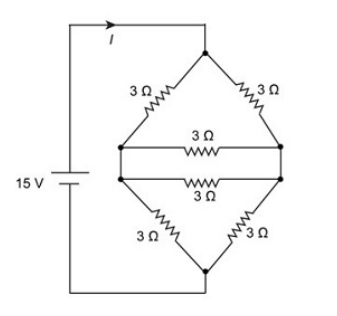
To determine the total current 'I' supplied by the voltage source, we need to find the equivalent resistance of the circuit and then use Ohm's Law.
- The circuit consists of a configuration known as a balanced Wheatstone bridge. The middle resistor can be ignored if the bridge is balanced, as it doesn't affect the equivalent resistance.
- All resistors are of 3 Ω. Let's calculate the equivalent resistance seen by the source:
Step 1: Ignore the Central Resistor: The two pairs of resistances (top and bottom) are in series, each pair having a total resistance of \(3\, \Omega + 3\, \Omega = 6\, \Omega\).
- These two 6 Ω resistors are in parallel. The equivalent resistance \(R_{\text{eq}}\) is given by:
\(R_{\text{eq}} = \frac{R_1 \times R_2}{R_1 + R_2} = \frac{6 \times 6}{6 + 6} = \frac{36}{12} = 3\, \Omega\)
- Step 2: Apply Ohm's Law (Voltage = Current × Resistance): The source voltage is 15 V.
The current \(I\) supplied by the source is:
\(I = \frac{V}{R} = \frac{15}{3} = 5\, A\)
- Therefore, the total current supplied by the voltage source is 5 A.
This matches option 5, which is the correct answer.
Important Questions from Series and Parallel Connection of Resistance
How much resistance must be connected in parallel with a 360 Ω resistor to obtain an equivalent resistance Req of 120 Ω?
If n identical resistance, each of resistance R, are connected in parallel, the equivalent resistance is:
- What is the value of equivalent resistance if the resistor 10 Ω is parallel to 20 Ω?
Three resisters of 3 ohm, 10 ohm and 15 ohm are connected in parallel in a 30 V circuit. The current will that flow through the 3-ohm resistor is:
- In which combination, the electrical appliances are connected at home?


