How much resistance must be connected in parallel with a 360 Ω resistor to obtain an equivalent resistance Req of 120 Ω?
180 Ω
Resistance Calculation in Parallel Circuits
Understanding how resistors behave when connected in a parallel circuit is fundamental in electrical engineering. When resistors are connected in parallel, the current divides among the branches, and the voltage across each resistor remains the same. The total or equivalent resistance of a parallel circuit is always less than the smallest individual resistance in the circuit.
Parallel Connection Formula
For two resistors, \(R_1\) and \(R_2\), connected in parallel, the equivalent resistance \(R_{eq}\) can be calculated using the formula:
\[ \frac{1}{R_{eq}} = \frac{1}{R_1} + \frac{1}{R_2} \]
This formula can also be rearranged to find \(R_{eq}\) as:
\[ R_{eq} = \frac{R_1 \cdot R_2}{R_1 + R_2} \]
However, when solving for an unknown resistance in a parallel circuit, the reciprocal sum formula \(\left( \frac{1}{R_{eq}} = \frac{1}{R_1} + \frac{1}{R_2} \right)\) is often more straightforward.
Resistor Problem Setup
In this problem, we are asked to find an unknown resistance that, when connected in parallel with a known 360 Ω resistor, results in an equivalent resistance of 120 Ω. Let's list the given values:
- First resistor (\(R_1\)) = 360 Ω
- Desired equivalent resistance (\(R_{eq}\)) = 120 Ω
- Unknown resistor to be found (\(R_2\)) = ?
Resistance Calculation Steps
We will use the formula for parallel resistances to determine the value of the unknown resistor \(R_2\). Starting with the reciprocal sum formula:
\[ \frac{1}{R_{eq}} = \frac{1}{R_1} + \frac{1}{R_2} \]
Substitute the given values into the equation:
\[ \frac{1}{120 \, \Omega} = \frac{1}{360 \, \Omega} + \frac{1}{R_2} \]
To find \(R_2\), we need to isolate the term \(\frac{1}{R_2}\). We can achieve this by subtracting \(\frac{1}{360 \, \Omega}\) from both sides of the equation:
\[ \frac{1}{R_2} = \frac{1}{120 \, \Omega} - \frac{1}{360 \, \Omega} \]
To subtract these fractions, we must find a common denominator. The least common multiple of 120 and 360 is 360.
\[ \frac{1}{R_2} = \frac{3 \times 1}{3 \times 120 \, \Omega} - \frac{1}{360 \, \Omega} \]
\[ \frac{1}{R_2} = \frac{3}{360 \, \Omega} - \frac{1}{360 \, \Omega} \]
Now, perform the subtraction:
\[ \frac{1}{R_2} = \frac{3 - 1}{360 \, \Omega} \]
\[ \frac{1}{R_2} = \frac{2}{360 \, \Omega} \]
Simplify the fraction by dividing both the numerator and the denominator by 2:
\[ \frac{1}{R_2} = \frac{1}{180 \, \Omega} \]
Finally, to find \(R_2\), we take the reciprocal of both sides of the equation:
\[ R_2 = 180 \, \Omega \]
Therefore, a 180 Ω resistor must be connected in parallel with the 360 Ω resistor to obtain an equivalent resistance of 120 Ω.
Important Questions from Series and Parallel Connection of Resistance
If n identical resistance, each of resistance R, are connected in parallel, the equivalent resistance is:
- What is the value of equivalent resistance if the resistor 10 Ω is parallel to 20 Ω?
Three resisters of 3 ohm, 10 ohm and 15 ohm are connected in parallel in a 30 V circuit. The current will that flow through the 3-ohm resistor is:
- In which combination, the electrical appliances are connected at home?
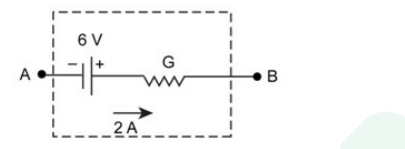
For the figure shown below, find the value of conductance 'G' (in S).