If n identical resistance, each of resistance R, are connected in parallel, the equivalent resistance is:
Equivalent Resistance of Identical Resistors in Parallel
When resistors are connected in parallel, the reciprocal of the equivalent resistance is equal to the sum of the reciprocals of individual resistances. This arrangement provides multiple paths for the current to flow.
The general formula for the equivalent resistance (\(R_{eq}\)) of resistors connected in parallel is:
\(\frac{1}{R_{eq}} = \frac{1}{R_1} + \frac{1}{R_2} + \frac{1}{R_3} + ... + \frac{1}{R_n}\)
In this specific problem, we are given that there are \(n\) identical resistors, and each resistor has a resistance of \(R\). So, \(R_1 = R_2 = ... = R_n = R\).
Substituting \(R\) for each individual resistance in the parallel formula, we get:
\(\frac{1}{R_{eq}} = \frac{1}{R} + \frac{1}{R} + \frac{1}{R} + ... + \frac{1}{R}\) (\(n\) times)
Adding the \(n\) identical terms:
\(\frac{1}{R_{eq}} = n \times \frac{1}{R}\)
\(\frac{1}{R_{eq}} = \frac{n}{R}\)
To find the equivalent resistance \(R_{eq}\), we take the reciprocal of both sides of the equation:
\(R_{eq} = \frac{R}{n}\)
Therefore, when \(n\) identical resistors, each of resistance \(R\), are connected in parallel, the equivalent resistance is \(\frac{R}{n}\).
Let's consider an example to solidify this concept. Suppose we have 4 identical resistors, each with a resistance of 10 ohms, connected in parallel. Here, \(n=4\) and \(R=10 \, \Omega\).
Using the formula \(R_{eq} = \frac{R}{n}\):
\(R_{eq} = \frac{10 \, \Omega}{4}\)
\(R_{eq} = 2.5 \, \Omega\)
This example shows how the equivalent resistance in a parallel connection of identical resistors is the individual resistance divided by the number of resistors.
Comparing this result with the given options:
- Option 1: \(n^2R\)
- Option 2: \(\frac{R}{n}\)
- Option 3: \(nR\) (This is for series connection)
- Option 4: \(\frac{R}{n^2}\)
The calculated equivalent resistance matches option 2.
Important Questions from Series and Parallel Connection of Resistance
How much resistance must be connected in parallel with a 360 Ω resistor to obtain an equivalent resistance Req of 120 Ω?
- What is the value of equivalent resistance if the resistor 10 Ω is parallel to 20 Ω?
Three resisters of 3 ohm, 10 ohm and 15 ohm are connected in parallel in a 30 V circuit. The current will that flow through the 3-ohm resistor is:
- In which combination, the electrical appliances are connected at home?
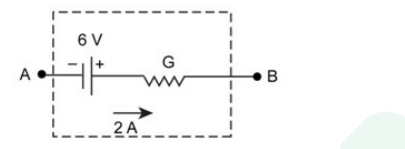
For the figure shown below, find the value of conductance 'G' (in S).