The departure of a line in a traverse surveying is a crucial concept for understanding navigational methods. When working with the concepts of traverse, it is vital to comprehend how the departure and latitude of a line are calculated using the properties of the angles involved.
In traverse surveying, the departure of a line is defined as its horizontal projection in the east or west direction. The departure of a line is determined using the following formula:
\(Departure = Length \times \sin(\text{Reduced Bearing})\)
Let's understand each component of this equation:
- Length: It is the actual measured distance of the line in the field.
- Reduced Bearing: It is the angle that the line makes with respect to the north or south, and its value ranges between 0° and 90°.
- Sine Function: In trigonometry, the sine of an angle in a right-angled triangle is defined as the ratio of the length of the side opposite the angle to the length of the hypotenuse. For calculating departure, we use the sine of the reduced bearing.
To verify why sine is used:
- If the line is aligned perfectly with the east or west direction, the angle of the bearing is either 0° or 180°, and the sine of these angles determines the contribution of the length to the departure.
- Because sine of 0° is 0, there is no contribution in the east-west direction if the line is aligned perfectly north or south.
Based on this understanding, the correct answer is Sine. Departure is obtained by multiplying the length of the line by the sine of its reduced bearing, which accurately captures the east-west component of the line.
Conclusion: For calculating the departure of a line, use the formula: \(Departure = Length \times \sin(\text{Reduced Bearing})\). This concludes that the option Sine is the correct answer.
Important Questions from Traversing
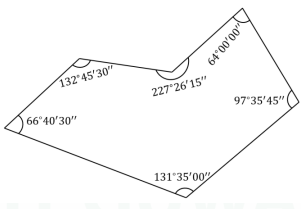
- The forebearing of four sides of a closed quadrilateral ABCDA are
AB = 60°, BC = 149.87°, CD = 269.5°, DA = 20.17°.
The calculated value of interior angle D is _____° (Answer in decimal degrees and rounded off to two decimal values). The angular misclosure of the closed-loop traverse shown in the figure is _____________ ° (Answer in decimal degrees and rounded off to three decimal places)
- It is needed to establish the coordinates of a station A. Two stations B and C are available whose coordinates are given in the table.
Length of line CA = 1212.38 m; ∠BCA = 64°.
The Easting of station A is _______ m (Rounded off to two decimal places).
Assume station A lies to the west of the traverse line BC.Station Easting (m) Northing (m) B 11054.09 9484.37 C 10827.62 10112.15 - If the departure and latitude of a line are 70 m and -130 m, respectively, then the whole circle bearing of the line in degrees is
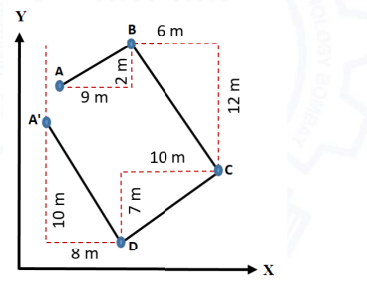
While carrying out a traverse survey ABCDA' using a theodolite with the originating station A, the departures and latitudes of the lines, as obtained, are shown in the following figure (not drawn to scale). It is seen that, due to the observational errors, the originating station A and its computed station A' are not the same. For this survey, the 'closing error' in m is