
1.The ancient Indo-Brahma river is believed to have split into three major drainage systems over time.
2.The Ganga and its Himalayan tributaries represent the central drainage system.
3.The western drainage system consists of the Brahmaputra and its tributaries.
Which of the above statements is/are correct?
Analyzing India's Drainage Systems Evolution
This question asks us to evaluate the correctness of three statements regarding the evolution of India's major drainage systems, particularly focusing on the ancient Indo-Brahma river and the classification of current river systems. Let's break down each statement:
Statement 1: Ancient Indo-Brahma River's Fate
The first statement suggests that the ancient Indo-Brahma river, a hypothesized precursor river, is believed to have split into three major drainage systems over geological time. This theory is supported by geological evidence. It is believed that this ancient river flowed across the northern part of the subcontinent. Due to the uplift of the Himalayas and the formation of the Delhi Ridge, the river's course was disrupted. It is theorized that this disruption led to its segmentation, eventually forming the Indus River system in the west, the Ganga-Brahmaputra system in the center, and the Brahmaputra River system in the east. Therefore, statement 1 is considered correct.
Statement 2: Ganga as Central Drainage System
The second statement posits that the Ganga River and its Himalayan tributaries constitute the central drainage system of India. The Ganga basin is the largest river system in India, covering a vast area. Its numerous tributaries, such as the Yamuna, Ghaghara, Gandak, and Kosi, originate from the Himalayas, carrying significant water resources. This system flows eastward across the Indo-Gangetic plain and eventually merges with the Brahmaputra before draining into the Bay of Bengal. Its geographical location and immense scale make it the central and most dominant drainage system on the subcontinent. Thus, statement 2 is correct.
Statement 3: Brahmaputra as Western Drainage System
The third statement claims that the western drainage system comprises the Brahmaputra River and its tributaries. This statement is incorrect. India's drainage systems are broadly categorized into the Arabian Sea drainage and the Bay of Bengal drainage. The western drainage system primarily includes rivers that flow westward into the Arabian Sea, such as the Indus River system (including its tributaries flowing through India), Narmada, Tapi, Sabarmati, and Mahi. The Brahmaputra River, however, originates in Tibet, flows eastward through Arunachal Pradesh and Assam, and then southward into Bangladesh, where it joins the Ganga. It is a major component of the eastern drainage system, ultimately draining into the Bay of Bengal. Therefore, the Brahmaputra is not part of the western drainage system. Statement 3 is incorrect.
Conclusion on Statements
Based on the analysis:
- Statement 1 is correct.
- Statement 2 is correct.
- Statement 3 is incorrect.
Therefore, the statements that are correct are 1 and 2.
Similar Questions
In which of the following protected areas is the historic "Taruba" lake located, renowned for being the oldest and largest national park in the state of Maharashtra?
Read the given below statements carefully and choose the correct option:
Assertion (A): The Chambal River is known for its badland topography called the Chambal ravines.
Reason (R): The Chambal flows through a deep gorge and eroded terrain before joining the Yamuna.- The Alaknanda River originates from which of the following?
- Which of the following rivers forms a delta along the Eastern Coastal Plains?
- Which of these rivers does not originate in the Peninsular Plateau of India?
Important Questions from Drainage System of India
With reference to river Teesta, consider the following statements:
1. The source of river Teesta is the same as that of Brahmaputra but it flows through Sikkim.
2. River Rangeet originates in Sikkim and it is a tributary of river Teesta.
3. River Teesta falls into Bay of Bengal at the border of India and Bangladesh.
Which of the statements given above is/are correct?
Consider the following rivers:
(1) Barak
(2) Lohit
(3) Subansiri
Which of the above flows/flow through Arunachal Pradesh?
Consider the following pairs:
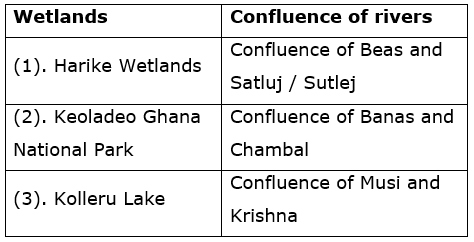
Which of the above pairs is/are correctly matched?
- Which river system is known for forming gorges in the Himalayan region?
- Which of the following rivers originates in the Western Ghats?



