
Neither I nor II
To determine the differentiability of the function \( f(x) = |x - 3| + |x - 4| \) at the points \( x = 3 \) and \( x = 4 \), let's analyze the behavior of the function around these points.
Understanding Differentiability:
A function is said to be differentiable at a point if it is continuous there and its left-hand derivative (LHD) and right-hand derivative (RHD) exist and are equal.
- At \( x = 3 \):
- For \( x < 3 \), the derivative is \(\frac{d}{dx}(3 - x + |x - 4|)\), evaluated as the slope of the function.
- For \( x > 3 \), the derivative is \(\frac{d}{dx}(x - 3 + |x - 4|)\).
- At \( x = 4 \):
- For \( x < 4 \), the derivative is \(\frac{d}{dx}(|x - 3| + 4 - x)\).
- For \( x > 4 \), the derivative is \(\frac{d}{dx}(|x - 3| + x - 4)\).
Conclusion: Because the function is not differentiable at either \( x = 3 \) or \( x = 4 \), the correct answer is "Neither I nor II".
Similar Questions
Suppose the function f(x) = x n, n ≠ 0 is differentiable for all x. Then n can be any element of the interval
The left-hand derivative of f(x) = [x] sin (πx) at x = k
Where k is an integer and [x] is the greatest integer function, isIf \({\rm{f}}\left( {\rm{x}} \right) = {\rm{x}}\left( {\sqrt {\rm{x}} - \sqrt {{\rm{x}} + 1} } \right)\) , then f(x) is
\({\rm{f}}\left( {\rm{x}} \right) = \left\{ {\begin{array}{*{20}{c}} {3{{\rm{x}}^2} + 12{\rm{x}} - 1,{\rm{\;\;}} - 1 \le {\rm{x}} \le 2}\\ {37 - {\rm{x}},{\rm{\;\;\;\;\;\;\;\;\;\;\;\;\;\;\;\;\;}}2 < {\rm{x}} \le 3} \end{array}} \right.\)
Which of the following statements is/are correct?
1. f(x) is increasing in the interval [-1, 2]
2. f(x) is decreasing in the interval (2, 3).
Select the correct answer using the code given below:
\({\rm{f}}\left( {\rm{x}} \right) = \left\{ {\begin{array}{*{20}{c}} {3{{\rm{x}}^2} + 12{\rm{x}} - 1,{\rm{\;\;}} - 1 \le {\rm{x}} \le 2}\\ {37 - {\rm{x}},{\rm{\;\;\;\;\;\;\;\;\;\;\;\;\;\;\;\;\;}}2 < {\rm{x}} \le 3} \end{array}} \right.\)
Which of the following statements are correct?
1. f(x) is continuous at x = 2
2. f(x) attains greatest value at x = 2
3. f(x) is differentiable at x = 2
Select the correct answer using the code given below:
Consider the following statements:
1. The function f(x) is continuous at x = 0
2. The function f(x) is continuous at \({\rm{x}} = \frac{{\rm{\pi }}}{2}\)
Which of the above statements is/are correct?Consider the following statements:
1. The function f(x) is differentiable at x = 0
2. The function f(x) is differentiable at \({\rm{x}} = \frac{{\rm{\pi }}}{2}\) .
Which of the above statements is/are correct?What is f’(4) equal to?
What is f’’(2.5) equal to?
Consider the following functions:
1. \({\rm{f}}\left( {\rm{x}} \right) = \left\{ {\begin{array}{*{20}{c}} {\frac{1}{{\rm{x}}}{\rm{\;\;if\;\;x}} \ne 0}\\ {0{\rm{\;\;if\;\;x}} = 0} \end{array}} \right.\)
2. \({\rm{f}}\left( {\rm{x}} \right) = \left\{ {\begin{array}{*{20}{c}} {2{\rm{x}} + 5{\rm{\;\;if\;\;x}} > 0}\\ {{{\rm{x}}^2} + 2{\rm{x}} + 5{\rm{\;\;if\;\;x}} \le 0} \end{array}} \right.\)
Which of the above functions is/are derivable at x = 0?
Important Questions from Differentiability
A differentiable function $f(x)$ is such that $f(-0.1) = 2, f(0) = 1, \text{ and } f(0.1) = 2$.
Then, $\frac{d^2f}{dx^2}$ at $x = 0$ is ______ (answer in integer).
- The differential of the equation, $x^2 + y^2 =1$, with respect to $x$ is
Suppose the function f(x) = x n, n ≠ 0 is differentiable for all x. Then n can be any element of the interval
The figure shows the distance vs time graph of a moving particle. The tangents to the curve at A and B make angles of $45^\circ$ and $60^\circ$ respectively with the time axis.
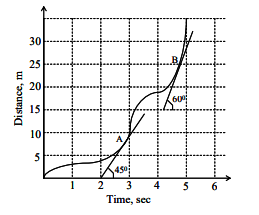
The ratio of the speeds of the particle at B and at A isDerivative of cos x with respect to x is



