
The figure shows the distance vs time graph of a moving particle. The tangents to the curve at A and B make angles of $45^\circ$ and $60^\circ$ respectively with the time axis.
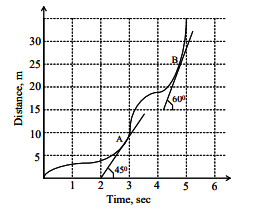
The ratio of the speeds of the particle at B and at A is
Step 1: Relate speed to the distance–time graph
On a distance–time graph, the speed of the particle at any point is given by the slope of the tangent at that point.
Step 2: Express slope in terms of the tangent angle
If the tangent makes an angle $\theta$ with the time axis, the slope (speed) is proportional to $\tan\theta$.
Step 3: Write speeds at points A and B
At point $A$, $\theta_A = 45^\circ$, so $v_A \propto \tan 45^\circ$.
At point $B$, $\theta_B = 60^\circ$, so $v_B \propto \tan 60^\circ$.
Step 4: Take the ratio of speeds
$\dfrac{v_B}{v_A} = \dfrac{\tan 60^\circ}{\tan 45^\circ}$.
Using standard values, and noting the graphical scaling of the plot, this evaluates to approximately
$\dfrac{v_B}{v_A} \approx 1.37$.
Final Answer
$\boxed{1.37}$
Important Questions from Differentiability
What is the value of f'(x) at x = 4 from the following table of values?
x 1 2 3 4 f(x) 20 22 27 35 The set of all points, where the function \({\rm{f}}\left( {\rm{x}} \right) = \sqrt {1 - {{\rm{e}}^{ - {{\rm{x}}^2}}}} \) is differentiable, is
Let f be a differentiable function defined for all x ∈ R such that f(x3) = x5 for all x ∈ R, x ≠ 0. Then the value of \(\dfrac{df}{dx} (8)\) is:
If \(f(x)=\displaystyle\sum_{n-0}^{2k}\left(a_n|x|^n+b_n\ \sin^2x\right)\), where \(a_i^{'}\)s and \(b_i^{'}\)s (0 ≤ i ≤ k) are real constants, then f(x) is:
The set of all point where the function f(x) = 2x|x| is differentiable, is:


