
A differentiable function $f(x)$ is such that $f(-0.1) = 2, f(0) = 1, \text{ and } f(0.1) = 2$. Then, $\frac{d^2f}{dx^2}$ at $x = 0$ is ______ (answer in integer).
Approximating Second Derivative Using Central Difference
The problem asks for the value of the second derivative, $\frac{d^2f}{dx^2}$, at $x = 0$. We are given values of the differentiable function $f(x)$ at three points: $f(-0.1) = 2$, $f(0) = 1$, and $f(0.1) = 2$.
We can approximate the second derivative using the central difference formula. This formula is suitable when we have function values at equally spaced points around the point of interest.
Applying the Central Difference Formula
The central difference formula for the second derivative is:
$ \frac{d^2f}{dx^2}(x) \approx \frac{f(x+h) - 2f(x) + f(x-h)}{h^2} $In this problem:
- The point of interest is $x = 0$.
- The step size is $h = 0.1$, as the points are $-0.1, 0, 0.1$.
- $f(x+h) = f(0.1) = 2$.
- $f(x) = f(0) = 1$.
- $f(x-h) = f(-0.1) = 2$.
Calculating the Second Derivative
Substitute the values into the formula:
$ \frac{d^2f}{dx^2}(0) \approx \frac{f(0.1) - 2f(0) + f(-0.1)}{(0.1)^2} $ $ \frac{d^2f}{dx^2}(0) \approx \frac{2 - 2(1) + 2}{(0.1)^2} $ $ \frac{d^2f}{dx^2}(0) \approx \frac{2 - 2 + 2}{0.01} $ $ \frac{d^2f}{dx^2}(0) \approx \frac{2}{0.01} $ $ \frac{d^2f}{dx^2}(0) \approx 200 $The approximated value of the second derivative at $x = 0$ is 200.
Important Questions from Differentiability
- The differential of the equation, $x^2 + y^2 =1$, with respect to $x$ is
Suppose the function f(x) = x n, n ≠ 0 is differentiable for all x. Then n can be any element of the interval
The figure shows the distance vs time graph of a moving particle. The tangents to the curve at A and B make angles of $45^\circ$ and $60^\circ$ respectively with the time axis.
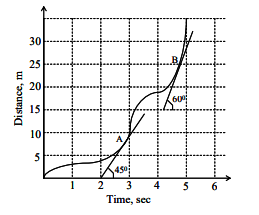
The ratio of the speeds of the particle at B and at A isDerivative of cos x with respect to x is
The left-hand derivative of f(x) = [x] sin (πx) at x = k
Where k is an integer and [x] is the greatest integer function, is


