
Derivative of cos x with respect to x is
– sin x
Derivative of Cos x Explained
Understanding the derivative of a function is a fundamental concept in differential calculus. A derivative essentially measures how a function changes as its input changes. For trigonometric functions like cosine, there are standard formulas that help us find their derivatives.
Derivative Concepts
In calculus, the derivative of a function represents the instantaneous rate of change of the function with respect to its independent variable. For a function \( f(x) \), its derivative with respect to \( x \) is denoted as \( f'(x) \) or \( \frac{df}{dx} \).
Standard Derivative Formulas
Many common functions have established derivative formulas that students learn and apply. These formulas are derived from the limit definition of a derivative but are used directly in most calculations. Here are some basic derivative rules, including the one for \( \cos x \):
| Function \( f(x) \) | Derivative \( \frac{d}{dx} f(x) \) |
|---|---|
| \( \text{constant} \) | \( 0 \) |
| \( x^n \) | \( nx^{n-1} \) |
| \( \sin x \) | \( \cos x \) |
| \( \cos x \) | \( -\sin x \) |
| \( e^x \) | \( e^x \) |
| \( \ln x \) | \( \frac{1}{x} \) |
Deriving Cos x
The question asks for the derivative of \( \cos x \) with respect to \( x \).
- As per the standard rules of differentiation in calculus, the derivative of the cosine function \( \cos x \) is well-defined.
- It is a direct formula that every calculus student learns.
- The derivative of \( \cos x \) with respect to \( x \) is \( -\sin x \).
- This can be written mathematically as:
- \[ \frac{d}{dx}(\cos x) = -\sin x \]
Therefore, when we differentiate \( \cos x \) with respect to \( x \), the result is \( -\sin x \).
Important Questions from Differentiability
A differentiable function $f(x)$ is such that $f(-0.1) = 2, f(0) = 1, \text{ and } f(0.1) = 2$.
Then, $\frac{d^2f}{dx^2}$ at $x = 0$ is ______ (answer in integer).
- The differential of the equation, $x^2 + y^2 =1$, with respect to $x$ is
Suppose the function f(x) = x n, n ≠ 0 is differentiable for all x. Then n can be any element of the interval
The figure shows the distance vs time graph of a moving particle. The tangents to the curve at A and B make angles of $45^\circ$ and $60^\circ$ respectively with the time axis.
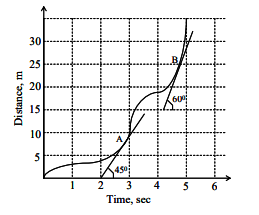
The ratio of the speeds of the particle at B and at A isThe left-hand derivative of f(x) = [x] sin (πx) at x = k
Where k is an integer and [x] is the greatest integer function, is


