
Solving Differential of x2 + y2 = 1
The question asks for the differential of the equation $x^2 + y^2 = 1$ with respect to $x$. This requires finding the derivative $\frac{dy}{dx}$ using implicit differentiation.
Implicit Differentiation Steps
- Differentiate both sides of the equation $x^2 + y^2 = 1$ with respect to $x$.
$ \frac{d}{dx}(x^2 + y^2) = \frac{d}{dx}(1) $
- Apply the power rule for $x^2$ and the chain rule for $y^2$ (since $y$ is a function of $x$). The derivative of a constant (1) is 0.
$ \frac{d}{dx}(x^2) + \frac{d}{dx}(y^2) = 0 $
$ 2x + 2y \frac{dy}{dx} = 0 $
- Isolate the term containing $\frac{dy}{dx}$.
$ 2y \frac{dy}{dx} = -2x $
- Solve for $\frac{dy}{dx}$.
$ \frac{dy}{dx} = \frac{-2x}{2y} $
$ \frac{dy}{dx} = -\frac{x}{y} $
Conclusion
The differential of the equation $x^2 + y^2 = 1$ with respect to $x$ is $-\frac{x}{y}$. This matches Option A.
Important Questions from Differentiability
A differentiable function $f(x)$ is such that $f(-0.1) = 2, f(0) = 1, \text{ and } f(0.1) = 2$.
Then, $\frac{d^2f}{dx^2}$ at $x = 0$ is ______ (answer in integer).
Suppose the function f(x) = x n, n ≠ 0 is differentiable for all x. Then n can be any element of the interval
The figure shows the distance vs time graph of a moving particle. The tangents to the curve at A and B make angles of $45^\circ$ and $60^\circ$ respectively with the time axis.
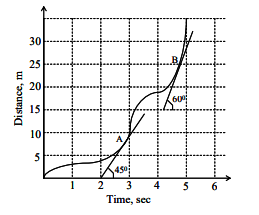
The ratio of the speeds of the particle at B and at A isDerivative of cos x with respect to x is
The left-hand derivative of f(x) = [x] sin (πx) at x = k
Where k is an integer and [x] is the greatest integer function, is


