
A. The horns of barchans point downwind, and barchans move in the downwind direction.
B. The horns of barchans point upwind, and barchans move in the upwind direction.
C. Barchans develop in areas of multidirectional winds and unlimited sand supply.
D. Barchans develop in areas of unidirectional winds and limited sand supply.
Choose the correct option.
Understanding Barchan Dunes
Barchan dunes, also known as crescent dunes, are fascinating desert landforms shaped by wind. They are characterized by their distinct crescent shape and are commonly found in sandy deserts and coastal environments worldwide.
Statement Analysis for Barchan Dunes
Statement A: The horns of barchans point downwind, and barchans move in the downwind direction.
This statement is correct. Barchan dunes are crescent-shaped, with the points or 'horns' of the crescent pointing in the direction the wind is blowing (downwind). The dune itself slowly migrates or moves in this same direction, pushed by the prevailing wind.
Statement B: The horns of barchans point upwind, and barchans move in the upwind direction.
This statement is incorrect. It contradicts the known characteristics of barchan dunes. As explained in Statement A, both the horns and the overall movement of the dune are directed downwind, not upwind.
Statement C: Barchans develop in areas of multidirectional winds and unlimited sand supply.
This statement is incorrect. Barchan dunes primarily form under conditions of unidirectional winds, meaning the wind blows consistently from a single direction. They also require a limited sand supply relative to the wind's capacity to move sand. An unlimited sand supply would typically lead to the formation of different types of dunes or larger dune fields.
Statement D: Barchans develop in areas of unidirectional winds and limited sand supply.
This statement is correct. These are the ideal conditions for barchan dune formation. Consistent wind from one direction shapes the dune into its characteristic crescent form, and the limited sand availability allows the dune to maintain this shape as it moves.
Conclusion on Barchan Dune Statements
Based on the analysis:
- Statement A is correct.
- Statement B is incorrect.
- Statement C is incorrect.
- Statement D is correct.
Therefore, the statements that are incorrect are B and C.
Correct Option Identification
Considering the analysis above, the option stating that 'B and C are incorrect' accurately reflects the characteristics of barchan dunes.
Important Questions from Geomorphology
- Match the following
A Evaporites O Ventifacts B Deflation P Desert varnish C Sandblasting Q Playa D Weathering R Desert pavement E Streamlined hills S Yardangs - Match List-I with List –II and select the correct answer using the codes given below the lists
List-I List-II A Bajada P Aeolian B Dreikanter Q Desert C Karn R Glacial D Dolines S Karst Indentify the sand dune forms that are likely to develop
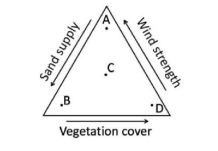
- If L=sediment load, $\text{D}_{50}$=median sediment size, $\bar{Q}$=mean discharge and S=slope then which one of the following relationships is correct?
- Unpaired non-cyclic river terraces are NOT associated with


