
Consider the following statements: 1. If ABC is a right-angled triangle, right-angled at A, and if sin \(\rm B = \frac 1 3,\) then cosec C = 3. 2. If b cos B = c cos C and if the triangle ABC is not right-angled, then ABC must be isosceles. Which of the above statements is/are correct?
2 only
Concept:
Pythagorous Theorem: In a right-angled triangle, the square of the hypotenuse is equal to the sum of the squares of the other two sides.
In triangle ABC with sides a, b, c, the sine rule:
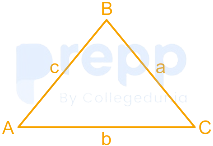
\(\rm \frac{\sin A}{a}=\frac{\sin B}{b}=\frac{\sin C}{c}=k\)
sin A - cos B =\(\rm 2\cos(\frac{A +B}{2})\sin(\frac{A -B}{2})\)
Calculation:
1. We have,
sin \(\rm B = \frac 1 3=\frac{P}{H}\)
Therefore, the right-angled triangle can be drawn as follows,
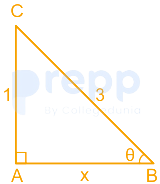
Here, P = 1
H = 3
B = x
Using the Pythagorean theorem,
32 = 12 + x2
x2 = 8
\(\therefore x=2\sqrt{2}\)
Now , Cosec C = \(\frac{3}{2\sqrt{2}}\)
Therefore, statement (1) is not correct.
2. It is given that,
b cos B = c cos C
Using the sine rule,
\(\rm \frac{\sin A}{a}=\frac{\sin B}{b}=\frac{\sin C}{c}=\frac{1}{K}\)
⇒ b = K sin B and c = K sin C
⇒ 2 sin B cos B = 2 sin C cos C
Let,
K = 2
⇒ 2 sin B cos B = 2 sin C cos C
⇒ sin 2B = sin 2C [2 sin x cos x = sin 2x]
⇒ sin 2B - sin 2C = 0
Using the formula:
sin C - sin D = 2 cos\((\frac{C+D}{2})\)× sin\((\frac{C-D}{2})\)
⇒ 2 cos (B + C) sin (B - C) = 0
In this case,
either,
cos (B + C) = 0
Therefore, (B + C) = 90° .... (1)
or,
or sin (B -C) = 0
B - C = 0
⇒ B = C .... (2)
From equations (1) and (2),
B = C = 45°
Therefore, ABC must be isosceles
Thus, option (2) is correct
Similar Questions
In a triangle ABC, a = (1 + √3) cm, b = 2 cm and angle C = 60°, then the other two angles are
Consider the following statements :
1. ABC is right angled triangle
2. The angles of the triangle are in AP
Which of the statements given above is/are correct ?
If c = 8, what is the area of the triangle ?
What is the value of a + b + √2 c equal to ?
What is the ratio of a2 ∶ b2 ∶ c2 ?
If the angles of a triangle ABC are in AP and b : c = √3 : √2, then what is the measure of angle A?
In a triangle ABC if a = 2, b = 3 and sin A = 2/3, then what is angle B equal to?
- The angles A, B and C of a triangle are in the ratio 1 : 1 : 4. If the longest side of the triangle is 3 units, then what is the perimeter of the triangle ?
- In a triangle \(ABC\), if \(a\), \(b\) and \(c\) are the lengths of the sides opposite to the angles \(A\), \(B\) and \(C\) respectively, then what is \(\frac{\sin(A-B)}{\sin(A+B)}\) equal to ?
The sides of a triangle are m, n and \(\rm \sqrt{m^2+n^2+mn}\) . What is the sum of the acute angles of the triangle?
Important Questions from Properties of Triangles
In a triangle ABC, a = (1 + √3) cm, b = 2 cm and angle C = 60°, then the other two angles are
Which of the following measures can form a triangle?
In a triangle ABC, sec A (sin B cos C + cos B sin C) equals:
Consider the following statements :
1. ABC is right angled triangle
2. The angles of the triangle are in AP
Which of the statements given above is/are correct ?
If c = 8, what is the area of the triangle ?



