
Analyzing the Hall Coefficient ($R_H$) and Fermi Energy ($E_F$) Relation
The Hall coefficient ($R_H$) is inversely proportional to the charge carrier density ($n$) and the charge of the carriers ($q$). For a metal with electrons as charge carriers (charge $-e$), the magnitude is:
$|R_H| = \frac{1}{ne}$The Sommerfeld model (free electron model) describes the Fermi energy ($E_F$) at absolute zero ($T=0K$) as a function of electron density ($n$):
$E_F = \frac{\hbar^2}{2m} (3\pi^2 n)^{2/3}$where $\hbar$ is the reduced Planck constant and $m$ is the electron mass.
Deriving the Proportionality
To find the relationship between $R_H$ and $E_F$, we first express $n$ in terms of $E_F$ from the Fermi energy equation:
- Rearrange the $E_F$ equation: $\left(\frac{2mE_F}{\hbar^2}\right) = (3\pi^2 n)^{2/3}$
- Raise both sides to the power of $3/2$: $\left(\frac{2mE_F}{\hbar^2}\right)^{3/2} = 3\pi^2 n$
- Solve for $n$: $n = \frac{1}{3\pi^2} \left(\frac{2mE_F}{\hbar^2}\right)^{3/2}$
Connecting $R_H$ and $E_F$
Now, substitute the expression for $n$ into the equation for $|R_H|$:
$|R_H| = \frac{1}{e \cdot n} = \frac{1}{e} \left[ \frac{3\pi^2}{\left(\frac{2mE_F}{\hbar^2}\right)^{3/2}} \right]$Simplify the expression:
$|R_H| = \left( \frac{3\pi^2 \hbar^6}{2e (2m)^{3/2}} \right) E_F^{-3/2}$The term in the parenthesis is a constant. Therefore, the Hall coefficient is proportional to $E_F$ raised to the power of $-3/2$.
$R_H \propto E_F^{-3/2}$Important Questions from Free Electron Theory Fermi Energy Velocity
- Copper has an electron number density of $8.3 \times 10^{28} \text{ m}^{-3}$. Its Fermi energy in eV (rounded off to one decimal place) is _____
($\hbar = 1.06 \times 10^{-34} \text{ J.s}$, mass of electron $\text{m}_e = 9.10 \times 10^{-31} \text{ kg}$, charge of electron $= 1.60 \times 10^{-19} \text{ C}$) - Consider one mole of a monovalent metal at absolute zero temperature, obeying the free electron model. Its Fermi energy is $E_F$. The energy corresponding to the filling of $\frac{N_A}{2}$ electrons, where $N_A$ is the Avogadro number, is $2^n E_F$. The value of $n$ is
Crystal structures of two metals A and B are two-dimensional square lattices with same lattice constant $a$. Electrons in metals behave as free electrons. The Fermi surfaces corresponding to A and B are shown by solid circles in figures.
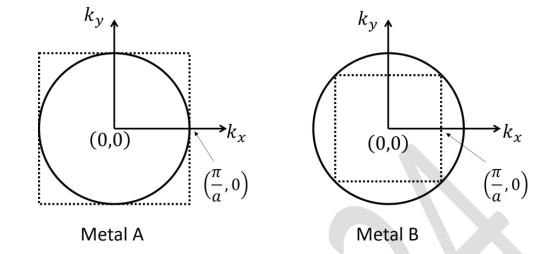
The electron concentrations in A and B are $n_A$ and $n_B$, respectively. The value of $(\frac{n_B}{n_A})$ isIf $X$ is the dimensionality of a free electron gas, the energy ($E$) dependence of density of states is given by $E^{½X-Y}$, where $Y$ is ________.
- Potassium metal has electron concentration of $1.4 \times 10^{28}m^{-3}$ and the corresponding density of states at Fermi level is $6.2 \times 10^{46}$ Joule$^{-1} m^{-3}$. If the Pauli paramagnetic susceptibility of Potassium is $n \times 10^{-k}$ in standard scientific form, then the value of $k$ (an integer) is __________ (Magnetic moment of electron is $9.3 \times 10^{-24}$ Joule T$^{-1}$; permeability of free space is $4\pi \times 10^{-7}$ T m A$^{-1}$)


