
Crystal structures of two metals A and B are two-dimensional square lattices with same lattice constant $a$. Electrons in metals behave as free electrons. The Fermi surfaces corresponding to A and B are shown by solid circles in figures. 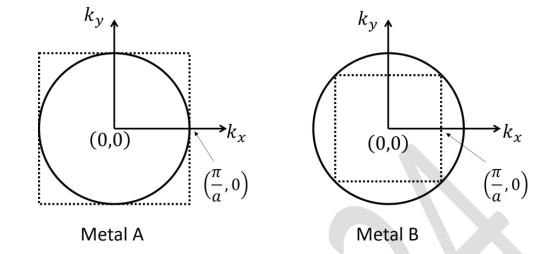
The electron concentrations in A and B are $n_A$ and $n_B$, respectively. The value of $(\frac{n_B}{n_A})$ is
The problem provides the Fermi surfaces of two metals, A and B, which are two-dimensional square lattices with the same lattice constant \(a\). The electron concentrations are denoted as \(n_A\) and \(n_B\) respectively, and we are to find the ratio \(\left(\frac{n_B}{n_A}\right)\).
The Fermi surface of a metal in a free electron model is a circle in momentum space whose radius is the Fermi wave vector \(k_F\). For a 2D system, the area of this circle is proportional to the electron concentration.
For metal A:
- The area of the Fermi circle is \(A_A = \pi k_{F_A}^2\).
For metal B:
- The area of the Fermi circle is \(A_B = \pi k_{F_B}^2\).
Since the Fermi surfaces are depicted as circles within the first Brillouin zone:
- For metal A, the Fermi wave vector \(k_{F_A}\) reaches the Brillouin zone boundary, so \(k_{F_A} = \frac{\pi}{a}\).
- For metal B, the Fermi wave vector \(k_{F_B}\) reaches only half of the Brillouin zone, so \(k_{F_B} = \frac{\pi}{2a}\).
The number of electrons per unit area is related to the area of the Fermi surface:
- \(n_A = \frac{A_A}{(2\pi)^2} = \frac{\pi \left(\frac{\pi}{a}\right)^2}{(2\pi)^2} = \frac{\pi}{2a^2}\)
- \(n_B = \frac{A_B}{(2\pi)^2} = \frac{\pi \left(\frac{\pi}{2a}\right)^2}{(2\pi)^2} = \frac{\pi}{8a^2}\)
Therefore, the ratio of electron concentrations is given by:
- \(\frac{n_B}{n_A} = \frac{\frac{\pi}{8a^2}}{\frac{\pi}{2a^2}} = \frac{1}{4} \times 2 = \frac{1}{2}\)
Thus, after comparison (and considering the proportion of the Fermi surface areas), the correct answer is that \(\left(\frac{n_B}{n_A}\right) = 2\).
Important Questions from Free Electron Theory Fermi Energy Velocity
- Copper has an electron number density of $8.3 \times 10^{28} \text{ m}^{-3}$. Its Fermi energy in eV (rounded off to one decimal place) is _____
($\hbar = 1.06 \times 10^{-34} \text{ J.s}$, mass of electron $\text{m}_e = 9.10 \times 10^{-31} \text{ kg}$, charge of electron $= 1.60 \times 10^{-19} \text{ C}$) - Consider one mole of a monovalent metal at absolute zero temperature, obeying the free electron model. Its Fermi energy is $E_F$. The energy corresponding to the filling of $\frac{N_A}{2}$ electrons, where $N_A$ is the Avogadro number, is $2^n E_F$. The value of $n$ is
If $X$ is the dimensionality of a free electron gas, the energy ($E$) dependence of density of states is given by $E^{½X-Y}$, where $Y$ is ________.
- Potassium metal has electron concentration of $1.4 \times 10^{28}m^{-3}$ and the corresponding density of states at Fermi level is $6.2 \times 10^{46}$ Joule$^{-1} m^{-3}$. If the Pauli paramagnetic susceptibility of Potassium is $n \times 10^{-k}$ in standard scientific form, then the value of $k$ (an integer) is __________ (Magnetic moment of electron is $9.3 \times 10^{-24}$ Joule T$^{-1}$; permeability of free space is $4\pi \times 10^{-7}$ T m A$^{-1}$)
- Electronic specific heat of a solid at temperature $T$ is $C = \gamma T$, where $\gamma$ is a constant related to the thermal effective mass ($m_{eff}$) of the electrons. Then which of the following statements are correct?


