
$-\frac{2}{3}$
To solve this problem, we need to analyze the energy levels in a system obeying the free electron model at absolute zero temperature.
In a free electron model, the Fermi energy E_F is defined as the maximum energy of electrons at absolute zero temperature. It is reached by electrons filling up states in k-space (momentum space) up to this energy.
Given:
- One mole of a monovalent metal.
- The Fermi energy is E_F.
We want the energy corresponding to the filling of \frac{N_A}{2} electrons, where N_A is Avogadro's number. This state is somewhere below the Fermi energy as it involves fewer electrons than the Fermi level occupies.
The relationship between energy and the number of electrons N\left(E\right) is derived from the density of states for the free electron model:
- The number of electrons N\left(E\right) filling states up to an energy E is proportional to E^{3/2}.
Thus, we have:
- N\left(E_F\right) \propto E_F^{3/2}
- N\left(E\right) = \frac{N_A}{2} \propto E^{3/2}
Equating the proportions gives:
- \frac{N_A}{2} = N\left(E_F\right)\left(\frac{E}{E_F}\right)^{3/2} = N\left(E_F\right) \cdot \left(\frac{1}{2}\right)\right)^{3/2}
Simplifying, we find:
- E = \left(\frac{1}{2}\right)^{2/3} \cdot E_F
This matches the form given in the problem: E = 2^n \cdot E_F.
Taking logarithms and comparing:
- 2^n = \left(\frac{1}{2}\right)^{2/3} = 2^{-2/3}
Therefore, n = -\frac{2}{3}.
Thus, the correct value of n is indeed -\frac{2}{3}.
Important Questions from Free Electron Theory Fermi Energy Velocity
- Copper has an electron number density of $8.3 \times 10^{28} \text{ m}^{-3}$. Its Fermi energy in eV (rounded off to one decimal place) is _____
($\hbar = 1.06 \times 10^{-34} \text{ J.s}$, mass of electron $\text{m}_e = 9.10 \times 10^{-31} \text{ kg}$, charge of electron $= 1.60 \times 10^{-19} \text{ C}$) Crystal structures of two metals A and B are two-dimensional square lattices with same lattice constant $a$. Electrons in metals behave as free electrons. The Fermi surfaces corresponding to A and B are shown by solid circles in figures.
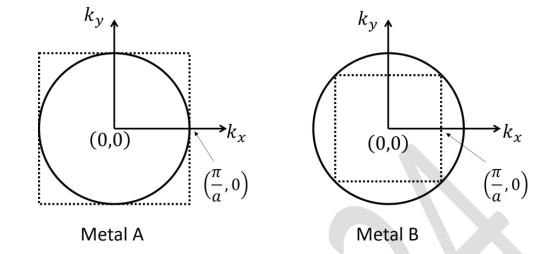
The electron concentrations in A and B are $n_A$ and $n_B$, respectively. The value of $(\frac{n_B}{n_A})$ isIf $X$ is the dimensionality of a free electron gas, the energy ($E$) dependence of density of states is given by $E^{½X-Y}$, where $Y$ is ________.
- Potassium metal has electron concentration of $1.4 \times 10^{28}m^{-3}$ and the corresponding density of states at Fermi level is $6.2 \times 10^{46}$ Joule$^{-1} m^{-3}$. If the Pauli paramagnetic susceptibility of Potassium is $n \times 10^{-k}$ in standard scientific form, then the value of $k$ (an integer) is __________ (Magnetic moment of electron is $9.3 \times 10^{-24}$ Joule T$^{-1}$; permeability of free space is $4\pi \times 10^{-7}$ T m A$^{-1}$)
- Electronic specific heat of a solid at temperature $T$ is $C = \gamma T$, where $\gamma$ is a constant related to the thermal effective mass ($m_{eff}$) of the electrons. Then which of the following statements are correct?


