
Potassium Pauli Paramagnetism: Finding k
The Pauli paramagnetic susceptibility (χp) quantifies the response of conduction electrons in a metal to an external magnetic field. It depends on the electron concentration (n), the density of states at the Fermi level (g(EF)), the electron magnetic moment (μB), and the permeability of free space (μ0). We use the formula:
$ \chi_p = \frac{3}{2} \frac{\mu_0 n \mu_B^2}{E_F} $
The Fermi energy (EF) is determined from n and g(EF) using the relation for a 3D free electron gas:
$ E_F = \frac{3n}{2 g(E_F)} $
Step 1: Calculate Fermi Energy (EF)
Given the electron concentration $ n = 1.4 \times 10^{28} \, \text{m}^{-3} $ and the density of states $ g(E_F) = 6.2 \times 10^{46} \, \text{J}^{-1} \text{ m}^{-3} $, we calculate EF:
$ E_F = \frac{3 \times (1.4 \times 10^{28} \, \text{m}^{-3})}{2 \times (6.2 \times 10^{46} \, \text{J}^{-1} \text{ m}^{-3})} = \frac{4.2 \times 10^{28}}{12.4 \times 10^{46}} \, \text{J} \approx 3.387 \times 10^{-19} \, \text{J} $
Step 2: Calculate Pauli Susceptibility (χp)
Using the constants $ \mu_0 = 4\pi \times 10^{-7} \, \text{T m A}^{-1} $ and $ \mu_B = 9.3 \times 10^{-24} \, \text{J T}^{-1} $, we substitute the values into the susceptibility formula:
$ \chi_p = 1.5 \times \frac{(4\pi \times 10^{-7} \, \text{T m A}^{-1}) \times (1.4 \times 10^{28} \, \text{m}^{-3}) \times (9.3 \times 10^{-24} \, \text{J T}^{-1})^2}{3.387 \times 10^{-19} \, \text{J}} $
Performing the calculation:
$ \chi_p \approx 1.5 \times \frac{(1.2566 \times 10^{-6}) \times (1.4 \times 10^{28}) \times (86.49 \times 10^{-48})}{3.387 \times 10^{-19}} $ $ \chi_p \approx 6.74 \times 10^{-6} $
Step 3: Determine the value of k
The calculated susceptibility is $ \chi_p \approx 6.74 \times 10^{-6} $. The question states the susceptibility is in the form $ n \times 10^{-k} $.
Comparing $ 6.74 \times 10^{-6} $ with $ n \times 10^{-k} $, we identify $ k = 6 $.
Important Questions from Free Electron Theory Fermi Energy Velocity
- Copper has an electron number density of $8.3 \times 10^{28} \text{ m}^{-3}$. Its Fermi energy in eV (rounded off to one decimal place) is _____
($\hbar = 1.06 \times 10^{-34} \text{ J.s}$, mass of electron $\text{m}_e = 9.10 \times 10^{-31} \text{ kg}$, charge of electron $= 1.60 \times 10^{-19} \text{ C}$) - Consider one mole of a monovalent metal at absolute zero temperature, obeying the free electron model. Its Fermi energy is $E_F$. The energy corresponding to the filling of $\frac{N_A}{2}$ electrons, where $N_A$ is the Avogadro number, is $2^n E_F$. The value of $n$ is
Crystal structures of two metals A and B are two-dimensional square lattices with same lattice constant $a$. Electrons in metals behave as free electrons. The Fermi surfaces corresponding to A and B are shown by solid circles in figures.
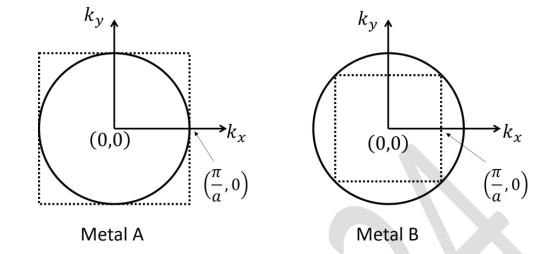
The electron concentrations in A and B are $n_A$ and $n_B$, respectively. The value of $(\frac{n_B}{n_A})$ isIf $X$ is the dimensionality of a free electron gas, the energy ($E$) dependence of density of states is given by $E^{½X-Y}$, where $Y$ is ________.
- Electronic specific heat of a solid at temperature $T$ is $C = \gamma T$, where $\gamma$ is a constant related to the thermal effective mass ($m_{eff}$) of the electrons. Then which of the following statements are correct?


