
Power Transistor Characteristics: MOSFET vs. BJT
This question asks us to identify the correct statement regarding the characteristics of two common types of power transistors: the Metal-Oxide-Semiconductor Field-Effect Transistor (MOSFET) and the Bipolar Junction Transistor (BJT). We need to consider their temperature coefficients and control mechanisms.
Analyzing Transistor Control Mechanisms
Let's first clarify how each transistor type is controlled:
- BJT (Bipolar Junction Transistor): A BJT is fundamentally a current-controlled device. The current flowing into the base terminal (IB) controls the larger current flowing between the collector and emitter terminals (IC). A small change in base current causes a larger change in collector current, often described by the current gain factor, Beta ($\beta$).
- MOSFET (Metal-Oxide-Semiconductor Field-Effect Transistor): A MOSFET is a voltage-controlled device. The voltage applied between the gate and source terminals (VGS) controls the current flowing between the drain and source terminals (ID). Applying a specific gate-source voltage creates or enhances a conductive channel, allowing current to flow.
Based on this, Option 3 ("BJT is a voltage controlled device") and Option 4 ("MOSFET is a current controlled device") are incorrect.
Understanding Temperature Coefficients
The temperature coefficient describes how a device's characteristics change with temperature. For power transistors, this often relates to how their on-state resistance or voltage drop changes:
- BJT Temperature Coefficient: As temperature increases, the base-emitter voltage (VBE) required to maintain a specific collector current tends to decrease. This decrease in required voltage leads to an increase in collector current for a fixed base current, or an increase in power dissipation. Effectively, BJTs tend to exhibit a negative temperature coefficient in terms of their base-emitter voltage characteristic, which can lead to thermal runaway if not managed properly. However, in terms of device resistance or forward voltage drop, it often leads to an *increase* in current-handling capability with temperature rise, a characteristic sometimes simplified or misinterpreted. The key point often tested is the Vbe characteristic.
- MOSFET Temperature Coefficient: As temperature increases, the resistance of the conductive channel in a MOSFET generally increases. This is primarily due to increased lattice scattering of charge carriers. An increase in resistance means that for a given drain-source voltage, the drain current decreases. This behaviour acts as a natural stabilizing factor, preventing thermal runaway, and is referred to as a positive temperature coefficient of resistance.
Evaluating the Options
- Option 1: MOSFET has negative temperature coefficient and BJT has positive temperature coefficient. (Incorrect based on standard characteristics)
- Option 2: BJT has negative temperature coefficient and MOSFET has positive temperature coefficient. (This aligns with the typical understanding of BJT Vbe characteristics and MOSFET resistance characteristics)
- Option 3: BJT is a voltage controlled device. (Incorrect, BJTs are current-controlled)
- Option 4: MOSFET is a current controlled device. (Incorrect, MOSFETs are voltage-controlled)
Conclusion
Considering both the control mechanisms and the temperature coefficients, the statement that accurately describes these power transistors is that the BJT exhibits a negative temperature coefficient (related to Vbe) while the MOSFET exhibits a positive temperature coefficient (related to its on-resistance).
Important Questions from Power Semiconductor Diodes and Transistors
Which semiconductor power device, out of the following, is not a current triggered device?
Diacs are primarily used as:
Which of the following circuit is used to obtain pulse gate triggering?
The figure shows a straight-line approximation for the forward characteristics of a power diode. A continuous on-state current of 15 A is flowing through the diode.
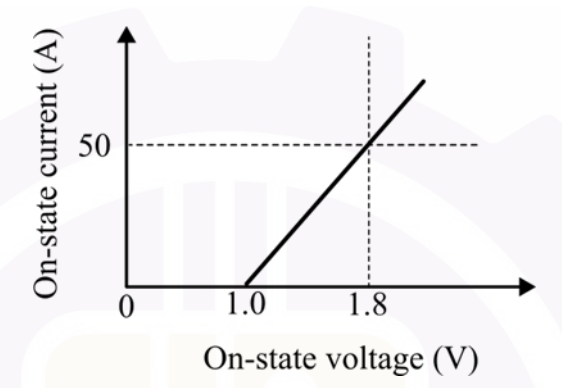
What is the power loss in the diode?
For a system with $G(S)=\frac{k}{S(S+1)(S+2)}$, $H(S)=1$. Determine the brake away point.


