
Question
Brittle deformation leads to
The correct answer is
faults and joints
Understanding Brittle Deformation Features
Brittle deformation occurs when rocks are subjected to stress and break or fracture rather than bending or flowing. This typically happens at lower temperatures and pressures, or when stress is applied rapidly.
Key Features of Brittle Deformation
- Faults: These are fractures in rock along which significant movement or displacement has occurred. They represent breaks where rocks have slipped past each other.
- Joints: These are fractures in rock where there has been little to no movement or displacement. They are essentially cracks that form due to tensile stress.
Analysis of Options
The question asks what brittle deformation leads to. Let's examine the options based on the understanding of brittle deformation:
- Option 1: Folds and joints - Folds are typically associated with ductile deformation, not brittle. Joints are correct.
- Option 2: Faults and dykes - Faults are a result of brittle deformation. Dykes are igneous intrusions and not a direct primary product of fracture patterns in brittle deformation, although they may exploit existing fractures.
- Option 3: Shear zones and folds - Shear zones can involve brittle components, but folds are primarily ductile features.
- Option 4: Faults and joints - Both faults (fractures with displacement) and joints (fractures without displacement) are characteristic features resulting directly from brittle fracturing of rocks under stress.
Therefore, faults and joints are the most accurate and direct results of brittle deformation.
Was this answer helpful?
Important Questions from Joints And Faults
- Which one of the following predicts the correct tectonic settings for development of the positive flower structure and the negative flower structure?
- Which one of the following is not typically associated with strike-slip faults?
- Which one of the following statements is correct?
- Shortening in the Earth's crust is typically accommodated by
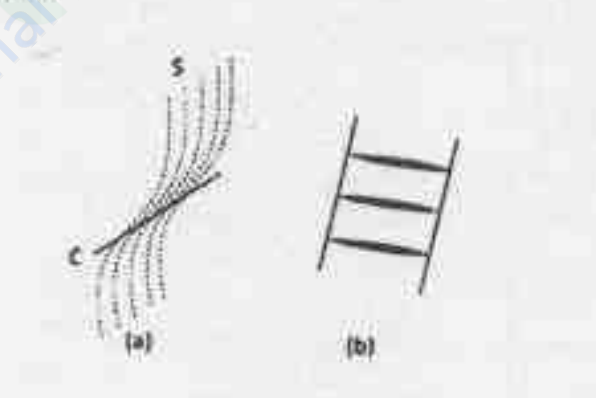
Figures (a) and (b) show S-C structure and en-echelon veins in two different shear zones. Which one of the following options is correct interpretation of sense of shear in figures (a) and (b)?
Need Expert Advice?


