Bowditch Rule Assumption
The Bowditch rule is a method used in surveying to adjust errors in a closed traverse.
This rule operates under a specific assumption regarding the relationship between the total probable error of the traverse and its perimeter.
Probable Error and Perimeter
The core assumption of the Bowditch rule is that the probable error in a traverse measurement is directly proportional to the square root of the total perimeter of the traverse.
If the perimeter is denoted by '$l$', the probable error is assumed to be proportional to:
This means as the total length of the traverse increases, the expected error increases, but not linearly; it grows at a slower rate, proportional to the square root of the length.
Important Questions from Traversing
- The forebearing of four sides of a closed quadrilateral ABCDA are
AB = 60°, BC = 149.87°, CD = 269.5°, DA = 20.17°.
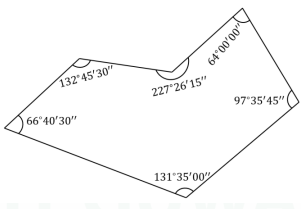
The calculated value of interior angle D is _____° (Answer in decimal degrees and rounded off to two decimal values). The angular misclosure of the closed-loop traverse shown in the figure is _____________ ° (Answer in decimal degrees and rounded off to three decimal places)
- It is needed to establish the coordinates of a station A. Two stations B and C are available whose coordinates are given in the table.
Length of line CA = 1212.38 m; ∠BCA = 64°.
The Easting of station A is _______ m (Rounded off to two decimal places).
Assume station A lies to the west of the traverse line BC.Station Easting (m) Northing (m) B 11054.09 9484.37 C 10827.62 10112.15 - If the departure and latitude of a line are 70 m and -130 m, respectively, then the whole circle bearing of the line in degrees is
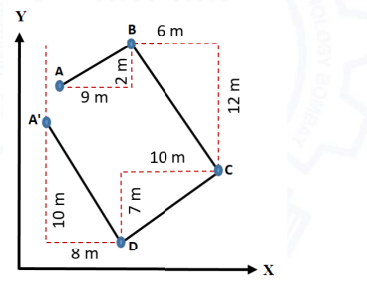
While carrying out a traverse survey ABCDA' using a theodolite with the originating station A, the departures and latitudes of the lines, as obtained, are shown in the following figure (not drawn to scale). It is seen that, due to the observational errors, the originating station A and its computed station A' are not the same. For this survey, the 'closing error' in m is