Letter Pair Analogy Reasoning
The question asks to identify the letter-cluster pair that does not follow the pattern established by the others. The pattern involves the relationship between letters based on their position in the English alphabet.
Analyzing Alphabetical Positions
First, let's determine the numerical position of each letter in the alphabet:
- A=1, B=2, ..., H=8, J=10, L=12, M=13, N=14, O=15, Q=17, R=18, S=19, T=20, V=22, X=24, Z=26
Pattern Identification
We examine the relationship within each pair and between the pairs for the options that seem similar:
- Option 1: HL−JN
- H (8) and L (12): The difference is \(12 - 8 = 4\).
- J (10) and N (14): The difference is \(14 - 10 = 4\).
- Relationship between pairs: H to J is \(10 - 8 = +2\). L to N is \(14 - 12 = +2\).
- Pattern: (X, X+4) followed by (X+2, X+4+2).
- Option 3: MQ−OS
- M (13) and Q (17): The difference is \(17 - 13 = 4\).
- O (15) and S (19): The difference is \(19 - 15 = 4\).
- Relationship between pairs: M to O is \(15 - 13 = +2\). Q to S is \(19 - 17 = +2\).
- Pattern: (X, X+4) followed by (X+2, X+4+2).
- Option 4: TX−VZ
- T (20) and X (24): The difference is \(24 - 20 = 4\).
- V (22) and Z (26): The difference is \(26 - 22 = 4\).
- Relationship between pairs: T to V is \(22 - 20 = +2\). X to Z is \(26 - 24 = +2\).
- Pattern: (X, X+4) followed by (X+2, X+4+2).
Analyzing the Odd Pair Out
Now, let's analyze Option 2 (NR−OV) using the same criteria:
- Option 2: NR−OV
- N (14) and R (18): The difference is \(18 - 14 = 4\). (This part matches the pattern).
- O (15) and V (22): The difference is \(22 - 15 = 7\). (This part deviates; the difference is not 4).
- Relationship between pairs: N to O is \(15 - 14 = +1\). R to V is \(22 - 18 = +4\). (These deviations also do not match the +2 pattern).
Conclusion
Options 1, 3, and 4 share a consistent pattern: each pair has letters separated by 4 positions, and the second pair's letters are 2 positions after the first pair's corresponding letters. Option 2 (NR−OV) breaks this pattern because the second pair (OV) has letters separated by 7 positions, not 4, and the progression between pairs is not +2.
Therefore, the letter-cluster pair that does not belong to the group is NR−OV.
Similar Questions
Based on the English alphabetical order, three of the following four letter-cluster pairs are alike in a certain way and thus form a group. Which pair does not belong to that group?
(Note: The odd one out is not based on the number of consonants/vowels or their position in the letter cluster.)
Based on the English alphabetical order, three of the following four letter-cluster pairs are alike in a certain way and thus form a group. Which pair does not belong to that group?
(Note: The odd one out is not based on the number of consonants/vowels or their position in the letter-cluster.)
Based on the English alphabetical order, three of the following four letter-cluster pairs are alike in a certain way and thus form a group. Which pair does not belong to that group?
(Note: The odd one out is not based on the number of consonants/vowels or their position in the letter-cluster.)Based on the English alphabetical order, three of the following four letter-cluster pairs are alike in a certain way and thus form a group. Which pair does not belong to that group?
(Note: The odd one out is not based on the number of consonants/vowels or their position in the letter-cluster.)Based on the English alphabetical order, three of the following four letter-clusters are alike in a certain way and thus form a group. Which letter-cluster does not belong to that group?
(Note: The odd one out is not based on the number of consonants/vowels or their position in the letter cluster.)Based on the English alphabetical order, three of the following four letter-cluster pairs are alike in a certain way and thus form a group. Which pair does not belong to that group?
(Note: The odd one out is not based on the number of consonants/vowels or their position in the letter cluster.)
Based on the English alphabetical order, three of the following four letter-clusters are alike in a certain way and thus form a group. Which letter-cluster does not belong to that group?
(Note: The odd one out is not based on the number of consonants/vowels or their position in the letter-cluster.)
Based on the English alphabetical order, three of the following four letter-cluster pairs are alike in a certain way and thus form a group. Which pair does not belong to that group?
(Note: The odd one out is not based on the number of consonants/vowels or their position in the letter cluster.)
Based on the English alphabetical order, three of the following four letter-cluster pairs are alike in a certain way and thus form a group. Which pair does not belong to that group?
(Note: The odd one out is not based on the number of consonants/vowels or their position in the letter-cluster.)
- Based on the English alphabetical order, three of the following four letter-clusters are alike in a certain way and thus form a group. Which letter-cluster DOES NOT belong to that group? (Note: The odd one out is not based on the number of consonants/vowels or their position in the letter-cluster.)
Important Questions from Classification
Directions for the following 3 (three) items : consider the given information and answer the three items that follow.
A, B, C, D, E, F and G are Lecturers from different cities—Hyderabad, Delhi, Shillong, Kanpur, Chennai, Mumbai and Srinagar (not necessarily in the same order) who participated in a conference. Each one of them is specialized in a different subject, viz., Economics, Commerce, History, Sociology, Geography, Mathematics and Statistics (not necessarily in the same order).
Further 1. Lecturer from Kanpur is specialized in Geography
2. Lecturer D is from Shillong
3. Lecturer C from Delhi is specialized in Sociology
4. Lecturer B is specialized in neither History nor Mathematics
5. Lecturer A who is specialized in Economics does not belong to Hyderabad
6. Lecturer F who is specialized in Commerce belongs to Srinagar
7. Lecturer G who is specialized in Statistics belongs to Chennai
Who is specialized in Geography?
A, B, C, D, E, F and G are Lecturers from different cities—Hyderabad, Delhi, Shillong, Kanpur, Chennai, Mumbai and Srinagar (not necessarily in the same order) who participated in a conference. Each one of them is specialized in a different subject, viz., Economics, Commerce, History, Sociology, Geography, Mathematics and Statistics (not necessarily in the same order).
Further 1. Lecturer from Kanpur is specialized in Geography
2. Lecturer D is from Shillong
3. Lecturer C from Delhi is specialized in Sociology
4. Lecturer B is specialized in neither History nor Mathematics
5. Lecturer A who is specialized in Economics does not belong to Hyderabad
6. Lecturer F who is specialized in Commerce belongs to Srinagar
7. Lecturer G who is specialized in Statistics belongs to Chennai
To which city does the Lecturer specialized in Economics belong?
A, B, C, D, E, F and G are Lecturers from different cities—Hyderabad, Delhi, Shillong, Kanpur, Chennai, Mumbai and Srinagar (not necessarily in the same order) who participated in a conference. Each one of them is specialized in a different subject, viz., Economics, Commerce, History, Sociology, Geography, Mathematics and Statistics (not necessarily in the same order).
Further 1. Lecturer from Kanpur is specialized in Geography
2. Lecturer D is from Shillong
3. Lecturer C from Delhi is specialized in Sociology
4. Lecturer B is specialized in neither History nor Mathematics
5. Lecturer A who is specialized in Economics does not belong to Hyderabad
6. Lecturer F who is specialized in Commerce belongs to Srinagar
7. Lecturer G who is specialized in Statistics belongs to Chennai
Who of the following belongs to Hyderabad?
In a school, there are five teachers A, B, C, D and E. A and B teach Hindi and English. C and B teach English and Geography. D and A teach Mathematics and Hindi. E and B teach History and French. Who teaches maximum numb, of subjects?
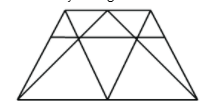
How many triangles are there in the given figure?