Fcc Lattice Interstitial Site Analysis
This solution determines the maximum radius ratio ($r/R$) for an atom that can fit into a specific interstitial site in an fcc lattice without causing distortion.
Lattice Geometry and Nearest Neighbours
- The crystal structure is face-centered cubic (fcc).
- Atoms are hard spheres with radius $R$.
- The lattice constant is $a$.
- In an fcc lattice, the nearest neighbour distance is $a/\sqrt{2}$.
- Since nearest neighbours touch, the distance between their centres is $2R$.
- Therefore, $2R = a/\sqrt{2}$, which implies $a = 2\sqrt{2}R$.
Interstitial Site and Constraints
- An interstitial site is located at coordinates $(0, a/2, 0)$.
- An atom with radius $r$ needs to fit into this site.
- The position $(0, a/2, 0)$ lies exactly halfway between the atom at the origin $(0,0,0)$ and the atom at $(0, a, 0)$.
- The distance from the origin $(0,0,0)$ to the interstitial site $(0, a/2, 0)$ is $a/2$.
- For the lattice not to be distorted, the interstitial atom must touch the surrounding lattice atoms without overlapping.
- The primary constraint comes from the atoms at $(0,0,0)$ and $(0, a, 0)$.
- The distance condition is: distance from origin centre to interstitial centre $\ge R + r$.
- So, $a/2 \ge R + r$.
Calculating Maximum Radius Ratio ($r/R$)
- Substitute the relationship $a = 2\sqrt{2}R$ into the inequality: $ \frac{2\sqrt{2}R}{2} \ge R + r $
- Simplify the expression: $ \sqrt{2}R \ge R + r $
- Rearrange to find the condition for $r$: $ r \le \sqrt{2}R - R $ $ r \le (\sqrt{2} - 1)R $
- Calculate the maximum ratio $r/R$: $ \frac{r}{R} \le \sqrt{2} - 1 $
- Using the approximate value $\sqrt{2} \approx 1.414$: $ \frac{r}{R} \le 1.414 - 1 $ $ \frac{r}{R} \le 0.414 $
The maximum value of $r/R$ is approximately $0.414$. This value lies within the given range of 0.4 to 0.42.
Important Questions from Crystal Structure Bravais Lattices Unit Cell
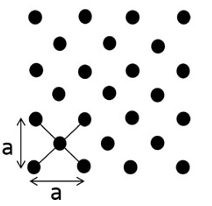
- For a two-dimensional hexagonal lattice with lattice constant $ a $, the atomic density is
- Consider a crystal that has a basis of one atom. Its primitive vectors are $ \vec{a_1} = a\hat{i} $, $ \vec{a_2} = a\hat{j} $, $ \vec{a_3} = \frac{a}{2}(\hat{i} + \hat{j} + \hat{k}) $, where $ \hat{i}, \hat{j}, \hat{k} $ are the unit vectors in the $ x, y $ and $ z $ directions of the Cartesian coordinate system and $ a $ is a positive constant. Which one of the following is the correct option regarding the type of the Bravais lattice?
- A compound consists of three ions X, Y and Z. The Z ions are arranged in an FCC arrangement. The X ions occupy $\frac{1}{6}$ of the tetrahedral voids and the Y ions occupy $\frac{1}{3}$ of the octahedral voids. Which one of the following is the CORRECT chemical formula of the compound?
For the given unit cells of a two dimensional square lattice, which option lists all the primitive cells?
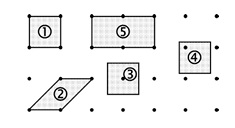
The number of distinct ways the primitive unit cell can be constructed for the two dimensional lattice as shown in the figure is ______.