As shown in the figure, a pump is designed as horizontal cylinder with a piston having area A and an outlet orifice having an area ‘a’. The piston moves with a constant velocity under the action of force F. If the density of the liquid is ρ, then the speed of the liquid emerging from the orifice is, (assume A >> a)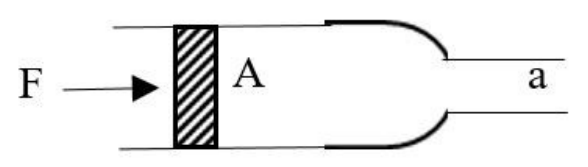
\(\sqrt{\dfrac{2F}{\rho A}}\)
The steady force on the piston raises the pressure of the liquid inside the cylinder above the outside pressure. Bernoulli's principle converts this excess pressure into kinetic energy of the jet, while the continuity equation relates the piston speed to the jet speed.
Step 1 — Excess pressure inside the cylinder: \(\Delta P = \dfrac{F}{A}\).
Step 2 — Bernoulli between the piston face and the orifice: \(\Delta P + \dfrac{1}{2}\rho u^{2} = \dfrac{1}{2}\rho v^{2}\), with continuity \(Au = av\), so \(u = \dfrac{a}{A}v\) is negligible for \(A \gg a\).
Step 3 — Hence \(\dfrac{F}{A} = \dfrac{1}{2}\rho v^{2} \Rightarrow v = \sqrt{\dfrac{2F}{\rho A}}\).
The expression \(\sqrt{\dfrac{F}{\rho A}}\) misses the factor 2 that comes from the kinetic energy term. Multiplying by \(\dfrac{a}{A}\) gives a speed of the order of the slow piston speed, not the jet speed, and multiplying by \(\dfrac{A}{a}\) applies the area ratio a second time.
\(\sqrt{\dfrac{2F}{\rho A}}\) option is correct.
Similar Questions
A train is moving along the tracks at a constant speed u. A girl on the train throws a ball of mass m straight ahead along the direction of motion of the train with speed v with respect to herself. Then
An earth’s satellite near the surface of the earth takes about 90 min per revolution. A satellite orbiting the moon also takes about 90 min per revolution. Then which of the following is true ?
[where ρm is density of the moon and ρe is density of the earth.]
There are n elastic balls placed on a smooth horizontal plane. The masses of the balls are m, \(\dfrac{m}{2},\dfrac{m}{2^{2}},....\dfrac{m}{2^{n-1}}\) respectively. If the first ball hits the second ball with velocity v0, then the velocity of the nth ball will be,
A uniform rope of length 4 m and mass 0.4 kg is held on a frictionless table in such a way that 0.6 m of the rope is hanging over the edge. The work done to pull the hanging part of the rope on to the table is, (Assume g = 10 m/s2)
Acceleration due to gravity at a height H from the surface of a planet is the same as that at a depth of H below the surface. If R be the radius of the planet, then H vs. R graph for different planets will be,
A mouse of mass m jumps on the outside edge of a rotating ceiling fan of moment of inertia I and radius R. The fractional loss of angular velocity of the fan as a result is,
A body of mass 2 kg moves in a horizontal circular path of radius 5 m. At an instant, its speed is 2√5 m/s and is increasing at the rate of 3 m/s2. The magnitude of force acting on the body at that instant is,
A particle of mass m is projected at a velocity u, making an angle θ with the horizontal (x-axis). If the angle of projection θ is varied keeping all other parameters same, then magnitude of angular momentum (L) at its maximum height about the point of projection varies with θ as,
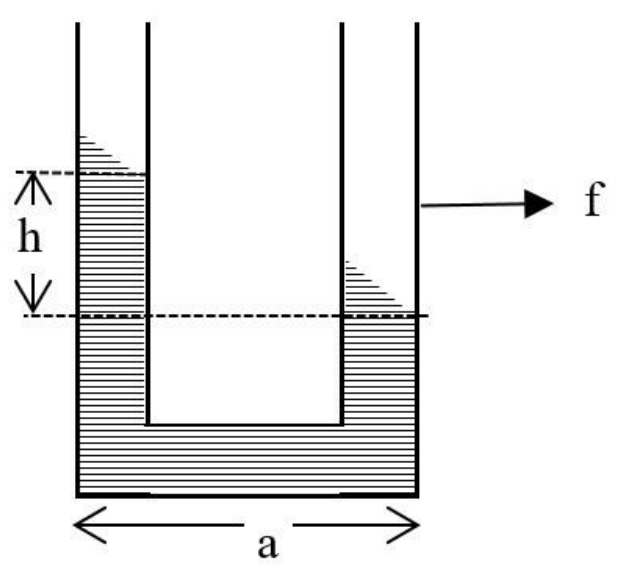
As shown in the figure, a liquid is at same levels in two arms of a U-tube of uniform cross-section when at rest. If the U-tube moves with an acceleration ‘f’ towards right, the difference between liquid heights between two arms of the U-tube will be, (acceleration due to gravity = g)
Two spheres S1 and S2 of masses m1 and m2 respectively collide with each other. Initially S1 is at rest and S2 is moving with velocity v along x-axis. After collision S2 has a velocity \(\dfrac{v}{2}\) in a direction perpendicular to the original direction. The sphere S1 moves after collision
Important Questions from Mechanics
- A soap bubble of surface tension $0.04 \text{ N/m}$ is blown to a diameter of $7 \text{ cm}$. If $(15000 - x) \text{ }\mu\text{J}$ of work is done in blowing it further to make its diameter $14 \text{ cm}$, then the value of $x$ is _______.
($\pi = 22/7$) - A uniform solid cylinder of length $L$ and radius $R$ has moment of inertia about its axis equal to $I_1$. A small co-centric cylinder of length $L/2$ and radius $R/3$ carved from this cylinder has moment of inertia about its axis equals to $I_2$. The ratio $I_1/I_2$ is _______.
- A fly wheel having mass $3\text{ kg}$ and radius $5\text{ m}$ is free to rotate about a horizontal axis. A string having negligible mass is wound around the wheel and the loose end of the string is connected to $3\text{ kg}$ mass. The mass is kept at rest initially and released. Kinetic energy of the wheel when the mass descends by $3\text{ m}$ is _________ $\text{J}$. ($g = 10\text{ m/s}^{2}$)
A fly wheel of mass $10$ kg and radius $50$ cm is rotating at a rate of$360$ rpm. Assuming mass to be concentrated at the rim, the constant retarding torque required to stop the rotation of wheel in $6$ rotations will be x Nm. The value of x is ____________.
A body moving horizontally on a smooth surface with a speed of $20$ $ms^{-1}$ splits into two parts and continue to move in the same direction. The masses of two parts are in the ratio of $1:2$. The smaller part moves with a speed of $30$ $ms^{-1}$. The fractional change is the kinetic energy is given by $\frac{1}{x}$. The value of x is__________