An earth’s satellite near the surface of the earth takes about 90 min per revolution. A satellite orbiting the moon also takes about 90 min per revolution. Then which of the following is true ? [where ρm is density of the moon and ρe is density of the earth.]
ρm = ρe
For a satellite skimming the surface of a spherical body, the gravitational pull of the body supplies the centripetal force, and the orbit radius is practically the radius R of the body itself.
Step 1 — Equating gravity with the centripetal requirement: \(\dfrac{GM}{R^{2}}=\dfrac{4\pi^{2}R}{T^{2}}\).
Step 2 — Writing the mass through the mean density, \(M=\dfrac{4}{3}\pi R^{3}\rho\), and substituting gives \(T^{2}=\dfrac{4\pi^{2}R^{3}}{GM}=\dfrac{3\pi}{G\rho}\).
Step 3 — So \(T=\sqrt{\dfrac{3\pi}{G\rho}}\): the period of a near-surface orbit depends only on the density of the central body, not on its size or mass separately.
Step 4 — Both satellites take about 90 min, so the two densities must be equal, \(\rho_{m}=\rho_{e}\).
A smaller or larger lunar density would make the lunar period longer or shorter than the earth value, which contradicts the equal periods. A definite conclusion is possible because the period fixes the density uniquely.
ρm = ρe option is correct.
Similar Questions
- A body of density '$\rho$' is dropped slowly on the surface of a lake of depth $d$. If the density of the lake water be '$\rho'$' ($\rho' < \rho$) then the time taken by the body to reach the bottom of the lake is
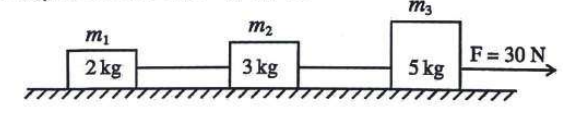
Three blocks of masses $m_1 = 2\text{ kg}$, $m_2 = 3\text{ kg}$ and $m_3 = 5\text{ kg}$ are placed on a horizontal frictionless surface and a force of 30N pulls the system as shown below. The value of tension in the string between $m_2$ and $m_3$ will be
- From a tower of height $H$, a particle is thrown vertically upwards with a speed $u$. The time taken by the particle to hit the ground is $n$ times that taken by it to reach the highest point of its path. The relation between $H$, $u$ and $n$ is
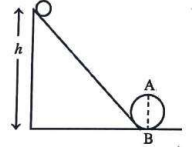
A body initially at rest and sliding along a frictionless track from a height '$h$' (as shown in figure) just completes a vertical circle of diameter AB = $d$. The height '$h$' is equal to
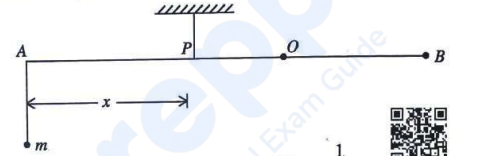
A uniform rod $AB$ is suspended from a point $P$, at a variable distance $x$, from $A$, as shown in figure. To make the rod horizontal, a mass '$m$' is suspended from its end $A$. Which set of variables will give a straight line when they are plotted?
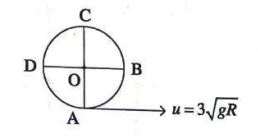
A particle of mass $m$ is suspended from a point O by a string of length $R$. It is given a velocity $u = 3\sqrt{gR}$ at the bottom. The difference in tension at point $B$ and at the point $C$ is
- Which of the velocity-time ($v-t$) graph(s) can possibly represent one-dimensional motion of a particle?
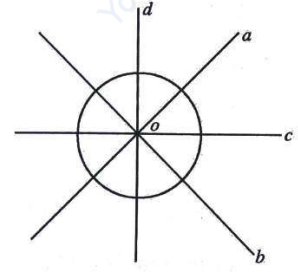
The moment of inertia of a thin disc about axes $a, b, c, d$ are $I_{1}, I_{2}, I_{3}$ and $I_{4}$ respectively, as shown in figure. If the moment of inertia about an axis passing through the centre and perpendicular to the plane of the disc is $I$ then,
A train is moving along the tracks at a constant speed u. A girl on the train throws a ball of mass m straight ahead along the direction of motion of the train with speed v with respect to herself. Then
There are n elastic balls placed on a smooth horizontal plane. The masses of the balls are m, \(\dfrac{m}{2},\dfrac{m}{2^{2}},....\dfrac{m}{2^{n-1}}\) respectively. If the first ball hits the second ball with velocity v0, then the velocity of the nth ball will be,
Important Questions from Mechanics
- A soap bubble of surface tension $0.04 \text{ N/m}$ is blown to a diameter of $7 \text{ cm}$. If $(15000 - x) \text{ }\mu\text{J}$ of work is done in blowing it further to make its diameter $14 \text{ cm}$, then the value of $x$ is _______.
($\pi = 22/7$) - A uniform solid cylinder of length $L$ and radius $R$ has moment of inertia about its axis equal to $I_1$. A small co-centric cylinder of length $L/2$ and radius $R/3$ carved from this cylinder has moment of inertia about its axis equals to $I_2$. The ratio $I_1/I_2$ is _______.
- A fly wheel having mass $3\text{ kg}$ and radius $5\text{ m}$ is free to rotate about a horizontal axis. A string having negligible mass is wound around the wheel and the loose end of the string is connected to $3\text{ kg}$ mass. The mass is kept at rest initially and released. Kinetic energy of the wheel when the mass descends by $3\text{ m}$ is _________ $\text{J}$. ($g = 10\text{ m/s}^{2}$)
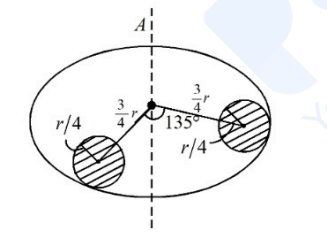
Suppose there is a uniform circular disc of mass $M \text{ kg}$ and radius $r \text{ m}$ shown in figure. The shaded regions are cut out from the disc. The moment of inertia of the remainder about the axis $A$ of the disc is given by $\frac{x}{256} M r^2$. The value of $x$ is ________.
- A ball of radius $r$ and density $\rho$ dropped through a viscous liquid of density $\sigma$ and viscosity $\eta$ attains its terminal velocity at time $t$, given by $t = A \rho^a r^b \eta^c \sigma^d$, where $A$ is a constant and $a$, $b$, $c$ and $d$ are integers. The value of $\frac{b+c}{a+d}$ is ________.