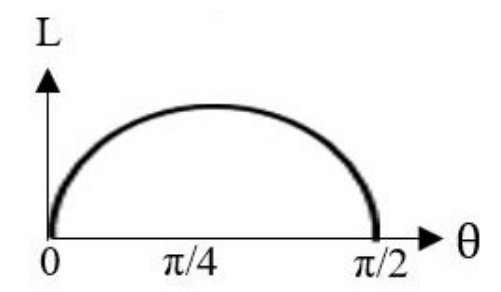
A particle of mass m is projected at a velocity u, making an angle θ with the horizontal (x-axis). If the angle of projection θ is varied keeping all other parameters same, then magnitude of angular momentum (L) at its maximum height about the point of projection varies with θ as,
Angular momentum of a point mass about a point is \(L = m v r_{\perp}\), where \(r_{\perp}\) is the perpendicular distance from the point to the line of the velocity. At the highest point of a projectile the velocity is horizontal, so the perpendicular distance from the launch point is simply the maximum height.
Step 1 — At the top, \(v = u\cos\theta\) and the height is \(H = \dfrac{u^2\sin^2\theta}{2g}\).
Step 2 — So \(L = m\,u\cos\theta \cdot \dfrac{u^2\sin^2\theta}{2g} = \dfrac{m u^3}{2g}\sin^2\theta\cos\theta\).
Step 3 — L = 0 at θ = 0 (no height) and at θ = π/2 (no horizontal velocity); for every angle in between L is positive, and \(\sin^2\theta\cos\theta\) rises to one maximum (at \(\tan\theta = \sqrt{2}\)) and then falls. The graph is therefore a single hump from 0 to π/2.
The curve that goes negative after π/4 is impossible for a magnitude; the double hump would need L = 0 at π/4, whereas there \(L = \dfrac{m u^3}{4\sqrt{2}\,g} \neq 0\); the rising straight line is non-zero at π/2, where L must vanish.
A single hump rising from zero at 0 and returning to zero at π/2 option is correct.
Similar Questions
A train is moving along the tracks at a constant speed u. A girl on the train throws a ball of mass m straight ahead along the direction of motion of the train with speed v with respect to herself. Then
An earth’s satellite near the surface of the earth takes about 90 min per revolution. A satellite orbiting the moon also takes about 90 min per revolution. Then which of the following is true ?
[where ρm is density of the moon and ρe is density of the earth.]
There are n elastic balls placed on a smooth horizontal plane. The masses of the balls are m, \(\dfrac{m}{2},\dfrac{m}{2^{2}},....\dfrac{m}{2^{n-1}}\) respectively. If the first ball hits the second ball with velocity v0, then the velocity of the nth ball will be,
A uniform rope of length 4 m and mass 0.4 kg is held on a frictionless table in such a way that 0.6 m of the rope is hanging over the edge. The work done to pull the hanging part of the rope on to the table is, (Assume g = 10 m/s2)
Acceleration due to gravity at a height H from the surface of a planet is the same as that at a depth of H below the surface. If R be the radius of the planet, then H vs. R graph for different planets will be,
A mouse of mass m jumps on the outside edge of a rotating ceiling fan of moment of inertia I and radius R. The fractional loss of angular velocity of the fan as a result is,
A body of mass 2 kg moves in a horizontal circular path of radius 5 m. At an instant, its speed is 2√5 m/s and is increasing at the rate of 3 m/s2. The magnitude of force acting on the body at that instant is,
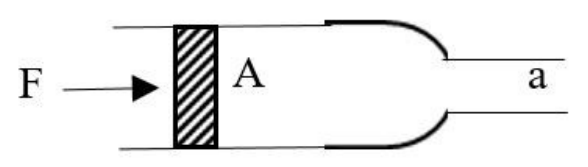
As shown in the figure, a pump is designed as horizontal cylinder with a piston having area A and an outlet orifice having an area ‘a’. The piston moves with a constant velocity under the action of force F. If the density of the liquid is ρ, then the speed of the liquid emerging from the orifice is, (assume A >> a)
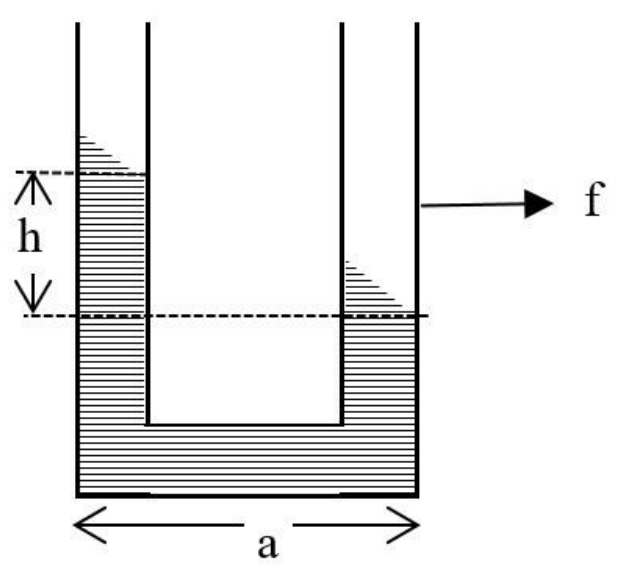
As shown in the figure, a liquid is at same levels in two arms of a U-tube of uniform cross-section when at rest. If the U-tube moves with an acceleration ‘f’ towards right, the difference between liquid heights between two arms of the U-tube will be, (acceleration due to gravity = g)
Two spheres S1 and S2 of masses m1 and m2 respectively collide with each other. Initially S1 is at rest and S2 is moving with velocity v along x-axis. After collision S2 has a velocity \(\dfrac{v}{2}\) in a direction perpendicular to the original direction. The sphere S1 moves after collision
Important Questions from Mechanics
- A soap bubble of surface tension $0.04 \text{ N/m}$ is blown to a diameter of $7 \text{ cm}$. If $(15000 - x) \text{ }\mu\text{J}$ of work is done in blowing it further to make its diameter $14 \text{ cm}$, then the value of $x$ is _______.
($\pi = 22/7$) - A uniform solid cylinder of length $L$ and radius $R$ has moment of inertia about its axis equal to $I_1$. A small co-centric cylinder of length $L/2$ and radius $R/3$ carved from this cylinder has moment of inertia about its axis equals to $I_2$. The ratio $I_1/I_2$ is _______.
- A fly wheel having mass $3\text{ kg}$ and radius $5\text{ m}$ is free to rotate about a horizontal axis. A string having negligible mass is wound around the wheel and the loose end of the string is connected to $3\text{ kg}$ mass. The mass is kept at rest initially and released. Kinetic energy of the wheel when the mass descends by $3\text{ m}$ is _________ $\text{J}$. ($g = 10\text{ m/s}^{2}$)
A fly wheel of mass $10$ kg and radius $50$ cm is rotating at a rate of$360$ rpm. Assuming mass to be concentrated at the rim, the constant retarding torque required to stop the rotation of wheel in $6$ rotations will be x Nm. The value of x is ____________.
A body moving horizontally on a smooth surface with a speed of $20$ $ms^{-1}$ splits into two parts and continue to move in the same direction. The masses of two parts are in the ratio of $1:2$. The smaller part moves with a speed of $30$ $ms^{-1}$. The fractional change is the kinetic energy is given by $\frac{1}{x}$. The value of x is__________