
$HCo(CO)_4$
Hydroformylation Catalyst Intermediate Identification
Hydroformylation, also known as the oxo process, involves adding a hydrogen atom and a formyl group (-CHO) across an olefin's double bond, typically producing aldehydes.
The catalyst mentioned is $Co_2(CO)_8$ (dicobalt octacarbonyl). In the presence of hydrogen (H$_2$) and carbon monoxide (CO) under pressure, this precatalyst activates to form the actual catalytic species.
Catalyst Activation
The primary pathway for activating $Co_2(CO)_8$ involves reaction with hydrogen gas to form the hydrido cobalt carbonyl complex. This is often represented by the equilibrium:
$ Co_2(CO)_8 + H_2 \rightleftharpoons 2 HCo(CO)_4 $
This equation shows the formation of $HCo(CO)_4$ (tetracarbonylhydridocobalt).
Role of $HCo(CO)_4$
- $HCo(CO)_4$ is widely recognized as the active species in cobalt-catalyzed hydroformylation.
- It participates directly in the key steps of the catalytic cycle, such as olefin coordination, migratory insertion, and hydrogenolysis.
Therefore, the intermediate formed from $Co_2(CO)_8$ during hydroformylation is $HCo(CO)_4$.
Important Questions from Organometallic Chemistry
- The species that undergoes $\beta$-elimination is
The heptacity of allyl and Cp and the ligation mode of NO in the thermodynamically stable complexes
$[(\eta^x-allyl)Ru(CO)_2(NO)]$ and $[(\eta^y-Cp)Ru(CO)_2(NO)]$,
respectively, are
(The heptacity of allyl and Cp are denoted by $\eta^x$ and $\eta^y$, respectively.)The bond angle (Ti-C-C) in the crystal structure of
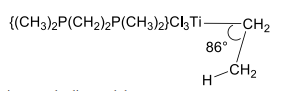
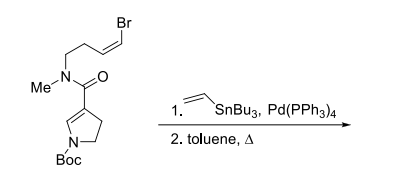
is severely distorted due toThe major product of the following reaction sequence is
Decarbonylation reaction of $[cis-(CH_3CO)Mn(^{13}CO)(CO)_4]$ yields X,Y and Z, where $X =[(CH_3)Mn(CO)_5]$; $Y = [cis-(CH_3)Mn(^{13}CO)(CO)_4]$; $Z = [trans-(CH_3)Mn(^{13}CO)(CO)_4]$
The molar ratio of the products(X : Y : Z) in this reaction is


