
An integrator output of the given triangular pulse is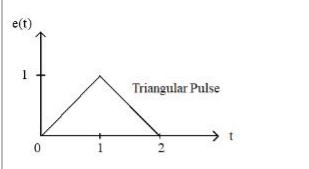
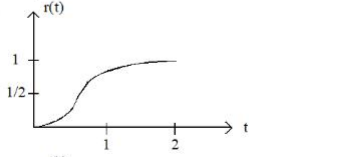
What an integrator does. An integrator produces the running (accumulated) area under its input:
\(r(t) = \int_{0}^{t} e(\tau)\,d\tau\)
Two consequences follow immediately and are enough to pick the waveform: (i) while the input is positive the output can only increase, and (ii) the slope of the output at any instant equals the value of the input at that instant.
The input. e(t) is a triangular pulse: it rises linearly from 0 to 1 over 0 ≤ t ≤ 1, falls linearly from 1 back to 0 over 1 ≤ t ≤ 2, and is zero afterwards. It is never negative.
Interval 0 ≤ t ≤ 1 (input rising, e(t) = t).
\(r(t)=\int_{0}^{t}\tau\,d\tau=\dfrac{t^{2}}{2}\)
This is a parabola whose slope starts at 0 and grows to 1 — a concave-up curve. At t = 1 it reaches \(r(1)=\tfrac{1}{2}\).
Interval 1 ≤ t ≤ 2 (input falling, e(t) = 2 − t). Area still accumulates, but at an ever-smaller rate, so the curve bends the other way (concave-down) and flattens out:
\(r(t)=\dfrac{1}{2}+\int_{1}^{t}(2-\tau)\,d\tau = -\dfrac{t^{2}}{2}+2t-\dfrac{3}{2}\)
At t = 2 this equals 1, which is just the total area of the triangle:
\(\text{Area}=\tfrac{1}{2}\times\text{base}\times\text{height}=\tfrac{1}{2}\times 2\times 1 = 1\)
For t > 2 the input is zero, so nothing more is added and the output holds constant at 1.
Shape of the answer. Putting the three pieces together gives a smooth, monotonically increasing S-shaped (sigmoid) curve: 0 at t = 0, concave up to \(\tfrac{1}{2}\) at t = 1 (the point of steepest slope, since the input peaks there), concave down to 1 at t = 2, then flat. That is the waveform of option 3.
Why the other shapes are wrong in principle. Any waveform that decreases anywhere is impossible for a non-negative input; a waveform made of straight lines would correspond to a rectangular input; and a triangular output would mean the integrator output falls after t = 1, which would require the input to go negative.
Key idea. Integration raises the order of a signal by one — a step integrates to a ramp, and a ramp (each side of this triangle) integrates to a parabola — and it always smooths the waveform.
Hence, the integrator output is the S-shaped curve rising from 0 to a final value of 1, passing through 1/2 at t = 1.
Important Questions from Introduction To Signals and Systems
All energy signals will have an average Power of
Arrange the following system types in ascending order of their intersection with 0 dB axis.
A. Type N system
B. Type 3 system
C. Type 2 system
D. Type 4 system
Choose the correct answer from the options given below
Given below are two statements
Statement I: The scaling theorem relates scale changes in frequency domain to the consequent changes in scale in the time domain.
Statement II: The scaling theorem is not applicable to an impulse signal.
In light of the above statements, choose the correct answer from the options given below
The period of the signal X(t) = cos (2 πt) cos (4 πt) – sin (2πt) sin (4πt) is
The time period of a 50 kHz sine wave is



