
An ammeter of range 0 to 10 A shows a current of 7.5 A. If its true value is 6.2 A, the relative error is ______.
20.96%
The ammeter reading is 7.5 A, while the true value is 6.2 A. The error is the difference between the measured value and the true value:
Error = Measured Value - True Value = 7.5 A - 6.2 A = 1.3 A
The relative error is the ratio of the error to the true value, expressed as a percentage:
Relative Error = \( \frac{\text{Error}}{\text{True Value}} \times 100\% \)
Substituting the values, we get:
Relative Error = \( \frac{1.3}{6.2} \times 100\% \approx 20.9677\% \)
Rounding to two decimal places, the relative error is approximately 20.97%. The closest option is 20.96%.
Similar Questions
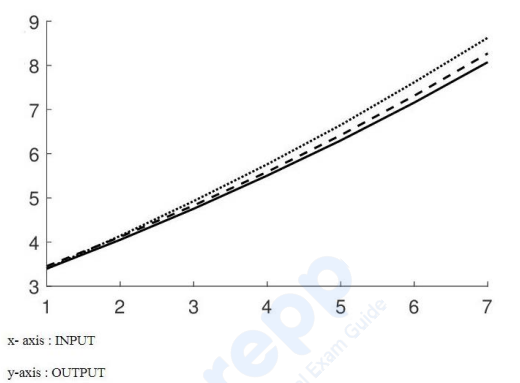
Identify the type of error the instrument shows as in the given figure.
Important Questions from Error Analysis
- Errors that occur after taking care of all gross and systematic errors are called as:
An ammeter of 0-50 A range has an accuracy of ± 1% of full scale reading. The current measured is 10 A. The uncertainty in measured value is
A 0-200 V voltmeter has an accuracy of 0.75% of full-scale reading. If the voltage measured is 100 V, the error is
Suppose that resistors R1 and R2 are connected in parallel to give an equivalent resistor R. If resistors R1 and R2 have tolerance of 1% each the equivalent resistor R for resistor R1 = 300 Ω and R2 = 200 Ω will have tolerance of
A \(4 \frac 1 2\) digit DMM has the error specification as 0.2% of reading +10 counts. If a d.c. voltage of 100 V is read on its 200 V full-scale, the maximum error that can be expected in the reading is



