
Among 80 students, 24 passed in Chemistry, 35 passed in Physics and 29 passed in Mathematics, 8 students did not appear for the examination. If 2 students have passed in all the three subjects, 2 students have passed in Physics and Chemistry both but not in Mathematics, 2 students have passed in Chemistry and Mathematics both but not in Physics, and 8 students have passed in Physics and Mathematics both but not in Chemistry, then how many students have passed in Mathematics only?
17
Understanding the Student Exam Data
The problem provides information about the performance of 80 students in three subjects: Chemistry, Physics, and Mathematics. We are given the number of students who passed in individual subjects and various combinations of subjects. Our goal is to find the number of students who passed only in Mathematics.
Analyzing the Given Information
Let's break down the numbers provided:
- Total students: 80
- Students who did not appear: 8
- Students who appeared (passed at least one subject): \(80 - 8 = 72\)
- Passed in Chemistry (C): \(|C| = 24\)
- Passed in Physics (P): \(|P| = 35\)
- Passed in Mathematics (M): \(|M| = 29\)
- Passed in Chemistry and Physics and Mathematics (C & P & M): \(|C \cap P \cap M| = 2\)
- Passed in Chemistry and Physics but not Mathematics (C & P only): \(|C \cap P \setminus M| = 2\)
- Passed in Chemistry and Mathematics but not Physics (C & M only): \(|C \cap M \setminus P| = 2\)
- Passed in Physics and Mathematics but not Chemistry (P & M only): \(|P \cap M \setminus C| = 8\)
Finding Pairwise Intersections
We are given the number of students who passed in pairs of subjects, excluding those who passed all three. We can use this to find the total number of students who passed in each pair:
- Chemistry and Physics (|C & P|):
\(|C \cap P| = |C \cap P \setminus M| + |C \cap P \cap M|\)
\(|C \cap P| = 2 + 2 = 4\) - Chemistry and Mathematics (|C & M|):
\(|C \cap M| = |C \cap M \setminus P| + |C \cap P \cap M|\)
\(|C \cap M| = 2 + 2 = 4\) - Physics and Mathematics (|P & M|):
\(|P \cap M| = |P \cap M \setminus C| + |C \cap P \cap M|\)
\(|P \cap M| = 8 + 2 = 10\)
Calculating Students Passed in Mathematics Only
To find the number of students who passed only in Mathematics, we need to take the total number of students who passed Mathematics and subtract those who also passed in Chemistry or Physics or both along with Mathematics. This can be calculated as:
Students passed in Mathematics only = (Total passed in Mathematics) - (Passed in C & M only) - (Passed in P & M only) - (Passed in C & P & M)
Using the notation:
\(|M \text{ only}| = |M| - |C \cap M \setminus P| - |P \cap M \setminus C| - |C \cap P \cap M|\)
Plugging in the values we have:
\(|M \text{ only}| = 29 - 2 - 8 - 2\)
\(|M \text{ only}| = 29 - (2 + 8 + 2)\)
\(|M \text{ only}| = 29 - 12\)
\(|M \text{ only}| = 17\)
Alternatively, using the total pairwise intersections:
\(|M \text{ only}| = |M| - |C \cap M| - |P \cap M| + |C \cap P \cap M|\)
\(|M \text{ only}| = 29 - 4 - 10 + 2\)
\(|M \text{ only}| = 29 - 14 + 2\)
\(|M \text{ only}| = 15 + 2\)
\(|M \text{ only}| = 17\)
Both methods give the same result.
Summary of Student Groups
| Group | Number of Students |
|---|---|
| Did not appear | 8 |
| Passed only in Chemistry | \(24 - (2 + 2 + 2) = 18\) |
| Passed only in Physics | \(35 - (2 + 8 + 2) = 23\) |
| Passed only in Mathematics | \(29 - (2 + 8 + 2) = 17\) |
| Passed in Chemistry & Physics only | 2 |
| Passed in Chemistry & Mathematics only | 2 |
| Passed in Physics & Mathematics only | 8 |
| Passed in Chemistry & Physics & Mathematics | 2 |
| Total Students (Sum of all groups) | \(8 + 18 + 23 + 17 + 2 + 2 + 8 + 2 = 80\) |
| Total Passed (Appeared) | \(18 + 23 + 17 + 2 + 2 + 8 + 2 = 72\) |
The calculation confirms that the number of students who passed in Mathematics only is 17.
Conclusion
Based on the given data and our step-by-step calculation using set theory principles, the number of students who passed in Mathematics only is 17.
Revision Table: Key Concepts
| Concept | Explanation |
|---|---|
| Set Theory | Used to model groups of students and their overlap in subject passes. |
| Union (\(\cup\)) | Represents students who passed in at least one of the subjects in the union. |
| Intersection (\(\cap\)) | Represents students who passed in all subjects in the intersection. |
| Set Difference (\(\setminus\)) | Represents students who passed in one set but not in another (e.g., C \(\setminus\) M means passed in C but not M). |
| Only in Subject X | Refers to students who passed *only* in Subject X and none of the others. This is calculated by taking the total in X and subtracting overlaps with other subjects. |
Additional Information: Venn Diagrams and Set Problems
Problems like this can often be visualized effectively using a Venn diagram. For three sets (Chemistry, Physics, Mathematics), a Venn diagram consists of three overlapping circles within a rectangle (representing the total universe of students). Each distinct region in the Venn diagram represents a specific combination of passing subjects (e.g., only Chemistry, Chemistry and Physics only, all three, etc.).
The steps to solve such problems using a Venn diagram typically involve:
- Drawing the diagram with overlapping circles for each set.
- Starting by filling in the innermost region: the intersection of all three sets.
- Using the given information about pairwise intersections (excluding the triple intersection) to fill in the regions where only two subjects overlap.
- Using the total for each individual subject to fill in the regions where only one subject is passed.
- Finally, using the total number of students (or students who appeared) and summing up all regions to check consistency and potentially find the number of students outside all sets (those who didn't pass any subject among those who appeared).
In this problem, we started with the triple intersection (2), then the pairwise intersections excluding the triple intersection (2, 2, 8). We could then calculate the number who passed in only one subject by subtracting the relevant intersection numbers from the total for that subject.
For example, to find students who passed only in Mathematics:
Total in M = (Only M) + (M & C only) + (M & P only) + (M & C & P)
\(29 = (\text{Only M}) + 2 + 8 + 2\)
\(29 = (\text{Only M}) + 12\)
\((\text{Only M}) = 29 - 12 = 17\)
This reinforces the formula used in the main solution.
Similar Questions
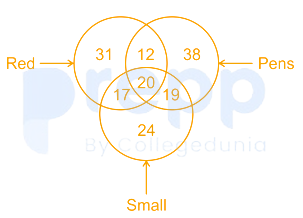
In the given figure, how many red are pens?
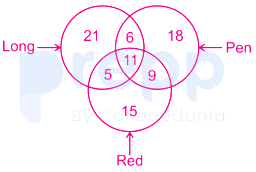
In the given figure, how many long pens are red?
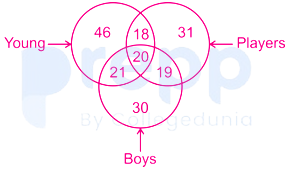
In the figure, how many players are young?
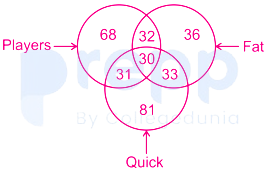
In the given figure, how many players are quick and fat?
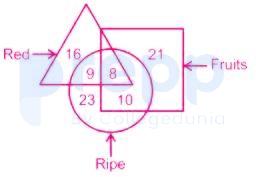
In the given figure, how many red fruits are ripe?
- An office has a total of 95 employees. Each employee participates in one or more of three activities, i.e. music, dance and skit, during the annual festival. The number of employees participating in only music is 20, whereas 14 participate in only skit, and 17 participate in only dance. A total of 8 employees participate in both music and skit only, 12 employees participate in all three activities, and 15 employees participate in both dance and skit only, whereas 9 employees participate in both music and dance only. Find the total number of employees participating in skit?
Study the given diagram carefully and answer the question. The numbers in different sections indicate the number of persons.
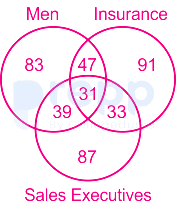
How many man are sales executives in the insurance industry?
- Observe the given Venn diagram and answer the following question.
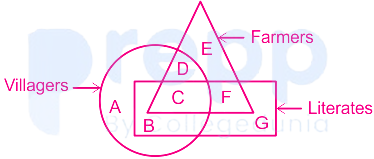
Which section stands for illiterate villagers who are farmers?
In a class of 170 students, 155 students take part in either one or more than one class of either guitar, drum or violin. A total of 21 students take part in any two of the classes. 54 students take part only in drum classes, whereas 43 students take part in violin class only. Only 5 students take part in all the three classes. How many students take part only in guitar classes?
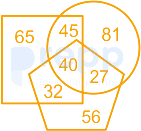
In the following Venn diagram, the pentagon stands for 'girls’, the square stands for ‘mobile phone users’, and the circle stands for ‘toppers’, The given numbers represent the number of persons in that particular category. How many girls are toppers but do NOT use mobile phones?
Important Questions from Venn Diagram Problems
In a group of 73 friends, 14 friends go to Gym and Karate classes both, whereas 7 friends neither go to Gym class nor to Karate class. If a total of 36 friends go to Gym class, then how many friends go to only Karate class?
In an examination 20% students failed in Mathematics and 15% failed in English. If 10% failed in both and those who passed in both numbered 300, then the total number of students who appeared in the examination was
In the following diagram, the 'circle' stands for 'soldiers', the 'square' stands for 'Indians', and the 'triangle' stands for 'singers'. The numbers given in the different segments represent persons belonging to that category.
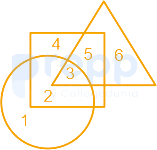
Which category is represented by the number '5'?
- In the following diagram, the circle stands for 'policemen', the square stands for 'sportspersons' and the 'triangle' stands for 'tax-payers' the numbers given in the different segments represent the number of persons in that category.
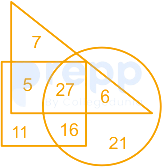
How many policemen are tax-payers but are NOT sportspersons?
The letter that represents the artists who are the doctors and dancers only is



