
All the resistances in the figure are 1 Ω each. The value of the current would be :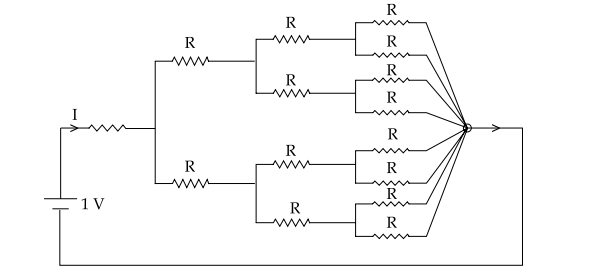
\(\dfrac{8}{15}\) A
The network is a symmetric binary tree, so collapse it from the far end inwards. Every split doubles the number of identical branches, and identical branches in parallel simply halve their resistance.
Level 3 — the eight outermost resistors. They come in four pairs, and each pair sits in parallel between the same two nodes:
\(R_{3}=\dfrac{1}{2}=0.5\ \Omega\)
Level 2 — work back one stage. Each of the four middle resistors is in series with one such pair, and those four branches then combine in pairs:
\(1+0.5=1.5\ \Omega\qquad \dfrac{1.5}{2}=0.75\ \Omega\)
Level 1 — back one more stage. Each of the two inner resistors is in series with 0.75 Ω, and the two results are in parallel:
\(1+0.75=1.75\ \Omega\qquad \dfrac{1.75}{2}=0.875\ \Omega\)
Add the single series resistor at the source.
\(R_{eq}=1+0.875=1.875\ \Omega=\dfrac{15}{8}\ \Omega\)
Finally, Ohm's law.
\(I=\dfrac{V}{R_{eq}}=\dfrac{1}{15/8}=\dfrac{8}{15}\ \text{A}\)
which is option 4.
| Stage | Series part | Two in parallel |
|---|---|---|
| Outermost pair | — | 0.5 Ω |
| Middle | 1 + 0.5 = 1.5 Ω | 0.75 Ω |
| Inner | 1 + 0.75 = 1.75 Ω | 0.875 Ω |
| Source resistor | 1 + 0.875 | 1.875 Ω |
The appearance of 15/8 is no accident. Each stage contributes half of what the previous stage contributed, so the total is the finite geometric sum
\(R_{eq}=1+\dfrac{1}{2}+\dfrac{1}{4}+\dfrac{1}{8}=\dfrac{15}{8}\)
and had the tree carried on branching for ever the total would approach exactly 2 Ω, giving 0.5 A. That is the fastest sanity check available: the answer must be a little more than half an amp, and 8/15 = 0.533 A is precisely that.
The habit worth taking away is to always simplify a ladder or tree from the end furthest from the source. Starting at the source leaves you with an unknown load at every step, whereas starting at the far end each combination is complete and the network shrinks by one stage each time.
Hence, the current supplied is 8/15 A.



