
Question
AB is the diameter of a circle. The chord CD is perpendicular to AB intersecting it at P. If CP = 2 and PB = 1, the radius of the circle is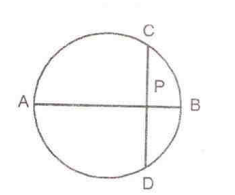
The correct answer is
2.5
The given problem involves a circle where AB is the diameter, and CD is a chord perpendicular to AB intersecting at P. We need to find the radius of the circle using the given information: CP = 2 and PB = 1.
To solve this, we can use the properties of circles and right triangles:
- Since AB is the diameter, the center of the circle, O, is the midpoint of AB. Thus, AO = OB = radius (r).
- In the right triangle CPB, by the Pythagorean theorem: \( CP^2 + PB^2 = CB^2 \).
- Substituting the given values: \( 2^2 + 1^2 = CB^2 \) which simplifies to \( 4 + 1 = CB^2 \), so \( CB = \sqrt{5} \).
- Since CD is perpendicular to AB and O is the midpoint of AB, OP is the radius.
- The right triangle OBP gives: \( OP^2 + PB^2 = OB^2 \).
- We have: \( OP^2 + 1^2 = r^2 \).
- To find OP, observe the triangle COP: \( CP^2 + OP^2 = CO^2 \).
- \( 4 + OP^2 = r^2 \).
- Since OP is a part of a larger radius: \( CO = r\).
- Equating: \( r^2 - OP^2 = 1 \) and \( r^2 = 4 + OP^2 \), solve them:
- From step 8 and 9:
- Let \( OP^2 = x \).
- Then, \( 4 + x = r^2 \).
- And \( r^2 - x = 1 \) combining gives:
- \( 4 + x - x = r^2 - x + x \subset 5 = r^2 \).
- Therefore, the radius is \( \sqrt{2.5} \).
- Thus, the radius of the circle is 2.5.
Therefore, the correct answer is 2.5.
Was this answer helpful?
Important Questions from Geometry (Notes)
- A 6 cm long chord of a circle is at a distance of 4 cm from the centre of the circle. Find the distance of 8 cm long chord of the same circle from the centre.
- In a triangle PQR, if $\angle P + \angle R = 150^\circ$ and $\angle P + 3\angle Q = 170^\circ$, then $\angle P$ is equal to :
- PQR is a triangle. The bisectors of the internal angle $\angle Q$ and external angle $\angle R$ intersect at M. If $\angle QMR = 40^\circ$, then $\angle P$ is :
- A $2\text{ m}$ long ladder is to reach a wall of height $1.75\text{ m}$. The largest possible horizontal distance of the ladder from the wall could be
Three-quarters of a circle is shown in the figure; OA and OB are two radii perpendicular to each other. C is a point on the circle.
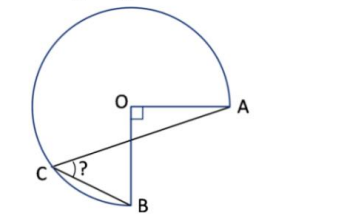
What is angle ACB?
Need Expert Advice?


