AB is parallel to CD. A transversal PQ intersects AB and CD at E and F, respectively, and ∠PEB = 38°. G is a point between AB and CD such that ∠BEG = 24° and ∠GFE = 29°. What is the measure of ∠EGF?
33°
P–E–F–Q is a straight line (the transversal), with P on the side of AB away from CD. Since ∠PEB = 38°, the angle on the other side of EB along the line is ∠BEF = 180° − 38° = 142°.
G lies between AB and CD, so ray EG lies inside ∠BEF. Hence ∠GEF = ∠BEF − ∠BEG = 142° − 24° = 118°.
In triangle EGF, ∠GEF = 118° and ∠GFE = 29°.
By the angle sum property, ∠EGF = 180° − 118° − 29° = 33°.
Hence, the answer is 33°.
Similar Questions
In Δ ABC, DE ∥ AC, where D and E are the points on sides AB and BC, respectively. If BD = 15 cm and AD = 4 cm, then what is the ratio of the area of Δ BDE to the trapezium ADEC?
The sides of two similar triangles are in the ratio 4 : 7. If the area of the smaller triangle is 144 cm2, find the area of the larger triangle.
In \(\Delta\)ABC, DE \(\parallel\) AC, where D and E are the points on sides AB and BC, respectively. If BD = 10 cm and AD = 4 cm, then what is the ratio of the area of \(\Delta\) BDE to the trapezium ADEC?
The sides of similar triangles ΔABC and ΔPQR are in the ratio 6 : 5. If area of ΔABC is equal to 72 cm2, what is the area of ΔPQR?
The ratio of the areas of two similar triangles is 81 : 121. The ratio of their corresponding heights is:
In triangle PQR, points S and T lie on PQ and PR, respectively, such that ST ∥ QR. If PS : SQ = 4 : 7 and PT = 12 cm, then PR is equal to:
In ΔRST, RS = 12 cm, ST = 10 cm, ∠RST = 50°, and ∠SRT = (3y)°. In another ΔUVW, UV = 12 cm, VW = 10 cm, ∠UVW = 50°, and ∠VUW = (2y + 20)°. What is the measure of the ∠VWU?
The sides of two similar triangles are in the ratio 3 : 5. If the area of the smaller triangle is 108 cm2, then find the area of the larger triangle.
Important Questions from Triangles, Congruence and Similarity
In a $\Delta ABC$, $\angle C = (9/4) \angle B = (3/2) (\angle A+\angle B)$. Find the measure of the angles.
- The areas of two similar triangles $\Delta$XYZ and $\Delta$LMN are 49 cm$^2$ and 9 cm$^2$, respectively. If LM = 9 cm, then the length of XY is:
Triangles \(PQR\) and \(ABC\) are similar triangles. Triangle \(ABC\) have the following sides
\(AB = 12 \text{ cm}\),
\(AC = 15 \text{ cm}\),
\(CB = 21 \text{ cm}\).
Triangle \(PQR\) have the following sides:
\(PQ = 4 \text{ cm}\),
\(RQ = 7 \text{ cm}\).
What is the length of side \(PR\)?
For a pair of similar triangles, the angles made at \(Q\) is same in both the triangles \(PQR\) and \(LQJ\).
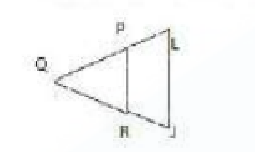
If the length of side \(QJ\) is 10 cm and \(QR\) is 5 cm, what is the ratio of their total areas?- In $\Delta ABC$ $\overline{PQ} \parallel \overline{AB}$. P and Q are on BC and CA respectively. If CQ : QA = 1 : 3 and CP = 4, then what is the value of BC?