
A polynomial ψ(s) = ansn + an-1sn-1 + ......+ a1s + a0 of degree n > 3 with constant real coefficients an, an-1, ... a0 has triple roots at s = -σ. Which one of the following conditions must be satisfied?
ψ(s) = 0, \(\frac{d\psi(s)}{ds}=0\) and \(\frac{d^2\psi(s)}{ds^2}=0\) at s = -σ
A triple root means \(\psi(s)=(s+\sigma)^3g(s)\) with \(g(-\sigma)\ne0\). Therefore ψ and its first two derivatives vanish at −σ, while its third derivative does not. The second option states the necessary vanishing conditions.
Important Questions from Differentiability
A differentiable function $f(x)$ is such that $f(-0.1) = 2, f(0) = 1, \text{ and } f(0.1) = 2$.
Then, $\frac{d^2f}{dx^2}$ at $x = 0$ is ______ (answer in integer).
- The differential of the equation, $x^2 + y^2 =1$, with respect to $x$ is
Suppose the function f(x) = x n, n ≠ 0 is differentiable for all x. Then n can be any element of the interval
The figure shows the distance vs time graph of a moving particle. The tangents to the curve at A and B make angles of $45^\circ$ and $60^\circ$ respectively with the time axis.
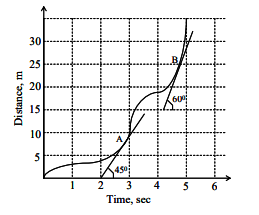
The ratio of the speeds of the particle at B and at A isDerivative of cos x with respect to x is


