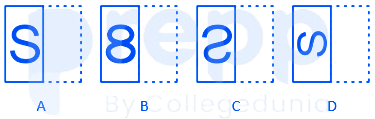
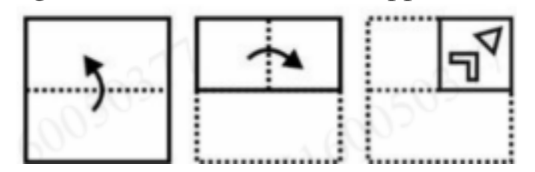
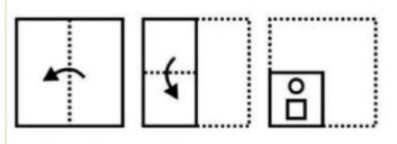
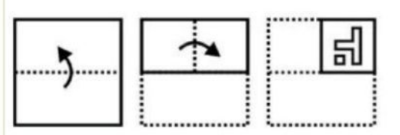
A piece of paper is folded and punched as shown below in the question figures. From the given option figures, indicate how it will appear when opened.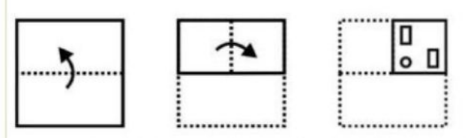
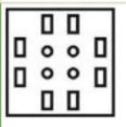
This is an image-based paper-folding and punching item, so it is solved by describing the unfolding logic honestly without inventing figure detail.
Every crease made while folding behaves as a line of symmetry, so a punch cut through the stacked layers prints a mirror-image hole across each fold once the paper is spread out.
Unfolding proceeds crease by crease, and each reversal reflects the current set of holes across that crease, doubling them along that direction.
The final flat sheet must carry the square and circular punches arranged symmetrically about each fold that was applied.
Of the four choices, only one keeps every hole correctly mirrored on all sides after both folds are undone.
The correct answer is the [Figure 3].
Similar Questions
A piece of paper is folded and punched as shown below in the question figures. From the given option figures, indicate how it will appear when opened.
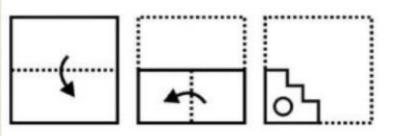
A piece of paper is folded and punched as shown below in the question figures. From the given option figures, indicate how it will appear when opened.
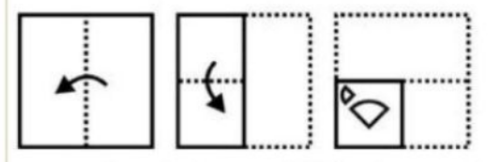
A piece of paper is folded and punched as shown below in the question figures. From the given option figures, indicate how it will appear when opened.
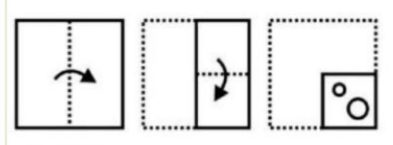
A piece of paper is folded and punched as shown below in the question figures. From the given option figures, indicate how it will appear when opened.
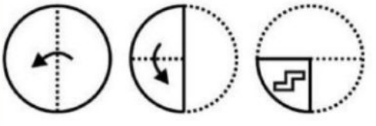
A piece of paper is folded and punched as shown below in the question figures. From the given option figures, indicate how it will appear when opened.
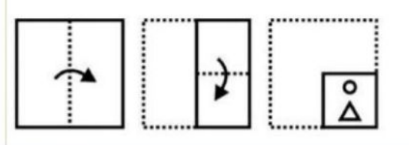
A piece of paper is folded and punched as shown below in the question figures. From the given option figures, indicate how it will appear when opened.
A piece of paper is folded and punched as shown below in the question figures. From the given option figures, indicate how it will appear when opened.
A piece of paper is folded and punched as shown below in the question figures. From the given option figures, indicate how it will appear when opened.
Important Questions from Paper Folding and Cutting
The sequence of folding a piece of paper and the manner in which the folded paper has been cut is shown in the following figures. How would this paper look when unfolded?

The sequence of folding a piece of paper and manner in which the folded paper has been cut is shown in the following figures. How would this paper look when unfolded?

The sequence of folding a piece of paper and the manner in which the folded paper has been cut is shown in the following figures. How would this paper look when unfolded?

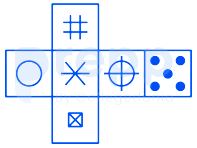
Which of the following cube in the answer figure cannot be made based on the unfolded cube in the question figure?
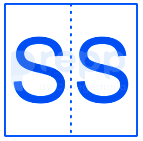
If the transparent sheet is folded at the dotted line, then the resulting figure is