
A particle of mass $m$ is suspended from a point O by a string of length $R$. It is given a velocity $u = 3\sqrt{gR}$ at the bottom. The difference in tension at point $B$ and at the point $C$ is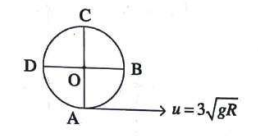
$4\text{ mg}$
To solve this problem, let's analyze the motion of the particle and calculate the tension difference at points B and C.
A particle of mass \(m\) is suspended from a point O by a string of length \(R\). Given a velocity \(u = 3\sqrt{gR}\) at the bottom (point A), it moves in a vertical circle, so we need to determine the tension difference between points B and C.
- Velocity at point B: At point A, the kinetic energy is given by: \(KE_A = \frac{1}{2} m u^2 = \frac{1}{2} m (3\sqrt{gR})^2 = \frac{1}{2} m \cdot 9gR = \frac{9}{2} mgR\).
The particle moves to point B. The change in height (\(\Delta h\)) from A to B is \(R\) (since B is R/4th of the circle above A).
Potential energy change is \(PE = mgR\).
At B, \(KE_B = \frac{9}{2}mgR - mgR = \frac{7}{2}mgR\).
Solve for velocity at B (\(v_B\)): \(\frac{1}{2} m v_B^2 = \frac{7}{2} mgR\).
Thus, \(v_B = \sqrt{7gR}\). - Velocity at point C: The change in height from A to C is \(2R\).
Potential energy at C is \(PE = 2mgR\).
At C, \(KE_C = \frac{9}{2}mgR - 2mgR = \frac{5}{2}mgR\).
So, \(v_C = \sqrt{5gR}\). - Tension at points B and C:
At point B, the centripetal force equation is: \(T_B - mg = \frac{m v_B^2}{R}\).
Substituting for \(v_B\): \(T_B - mg = \frac{m \cdot 7gR}{R} = 7mg\).
Thus, \(T_B = 8mg\).
At point C: \(T_C + mg = \frac{m v_C^2}{R}\).
Substituting for \(v_C\): \(T_C + mg = \frac{m \cdot 5gR}{R} = 5mg\).
Thus, \(T_C = 4mg\). - Difference in tension:
\(\Delta T = T_B - T_C = 8mg - 4mg = 4mg\).
Similar Questions
- A body of density '$\rho$' is dropped slowly on the surface of a lake of depth $d$. If the density of the lake water be '$\rho'$' ($\rho' < \rho$) then the time taken by the body to reach the bottom of the lake is
- From a tower of height $H$, a particle is thrown vertically upwards with a speed $u$. The time taken by the particle to hit the ground is $n$ times that taken by it to reach the highest point of its path. The relation between $H$, $u$ and $n$ is
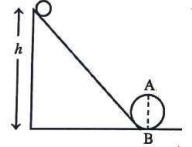
A body initially at rest and sliding along a frictionless track from a height '$h$' (as shown in figure) just completes a vertical circle of diameter AB = $d$. The height '$h$' is equal to
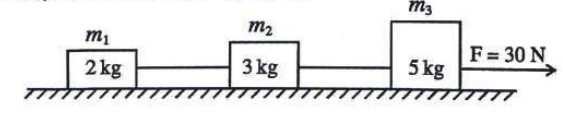
Three blocks of masses $m_1 = 2\text{ kg}$, $m_2 = 3\text{ kg}$ and $m_3 = 5\text{ kg}$ are placed on a horizontal frictionless surface and a force of 30N pulls the system as shown below. The value of tension in the string between $m_2$ and $m_3$ will be
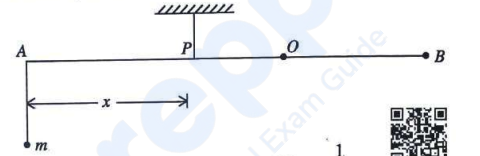
A uniform rod $AB$ is suspended from a point $P$, at a variable distance $x$, from $A$, as shown in figure. To make the rod horizontal, a mass '$m$' is suspended from its end $A$. Which set of variables will give a straight line when they are plotted?
- Which of the velocity-time ($v-t$) graph(s) can possibly represent one-dimensional motion of a particle?
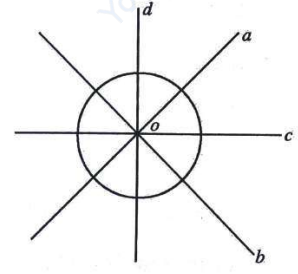
The moment of inertia of a thin disc about axes $a, b, c, d$ are $I_{1}, I_{2}, I_{3}$ and $I_{4}$ respectively, as shown in figure. If the moment of inertia about an axis passing through the centre and perpendicular to the plane of the disc is $I$ then,
Important Questions from Mechanics
- Two masses $m$ and $2m$ are connected by a light string going over a pulley (disc) of mass $30m$ with radius $r=0.1 \text{ m}$. The pulley is mounted in a vertical plane and it is free to rotate about its axis. The $2m$ mass is released from rest and its speed when it has descended through a height of 3.6 m is _________ m/s. (Assume string does not slip and $g = 10 \text{ m/s}^2$)
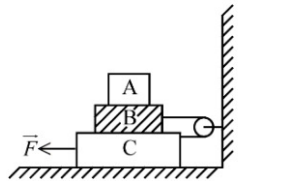
In the given figure the blocks $A$, $B$ and $C$ weigh 4 kg, 6 kg and 8 kg respectively. The co-efficient of sliding friction between any two surfaces is 0.5. The force $\vec{F}$ required to slide the block $C$ with constant speed is ______ N. (Use $g = 10 \text{ m/s}^2$)
- The fifth harmonic of a closed organ pipe is found to be in unison with the first harmonic of an open pipe. The ratio of lengths of closed pipe to that of the open pipe is $5/x$. The value of $x$ is _______.
- In a vernier callipers, 50 vernier scale divisions are equal to 48 main scale divisions. If one main scale division $= 0.05 \text{ mm}$, then the least count of the vernier callipers is _______ mm.
- A flexible chain of mass $m$ hangs between two fixed points at the same level. The inclination of the chain with the horizontal at the two points of support is $30^\circ$. Considering the equilibrium of each half of the chain, the tension of the chain at the lowest point is _______.


