A paper shown in Panel I is folded along the dashed lines (- - -) to construct a cube. The shaded regions shown in Panel I appear on the outer surface of the cube. Referring to cubes shown in Panel II, which one of the options is correct?
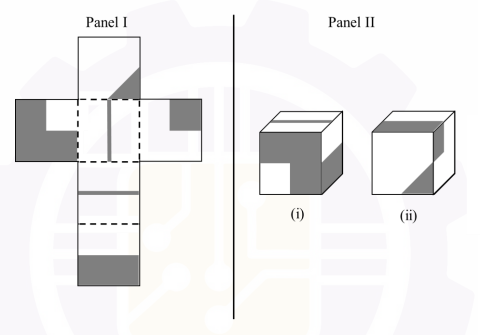
To solve this problem, we need to determine which cube configuration in Panel II can be constructed from the net provided in Panel I.
- First, observe the provided net in Panel I. It consists of six squares that will form the faces of the cube once folded. Notice the specific arrangement of shaded regions.
- When folding the net into a cube, each square will become one face of the cube. The challenge lies in visualizing the folding and matching shaded regions.
- Let's analyze each option:
- Option (i): This configuration does not match the shaded pattern from the net in Panel I when folded. Specifically, the alignment and position of the shaded squares do not correspond correctly.
- Option (ii): In this configuration, the shaded regions align perfectly with the possible folded arrangement of the net from Panel I. Each face of the cube corresponds to the expected pattern from the net.
- Thus, only option (ii) corresponds to the cube that can be formed from the net in Panel I.
Therefore, the correct answer is: Only (ii) can correspond to the unfolded cube in Panel I.
Important Questions from 2D 3D Pattern Visualization
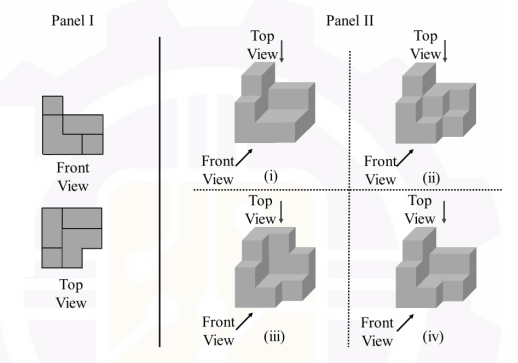
In Panel I of the figure below, the front view and top view of a structure are shown. Which one of the 3D structures shown in Panel II possesses the views shown in Panel I?
- Visualize two identical right circular cones such that one is inverted over the other and they share a common circular base. If a cutting plane passes through the vertices of the assembled cones, what shape does the outer boundary of the resulting cross-section make?
Three different views of a dice are shown in the figure below.
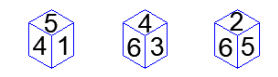
The piece of paper that can be folded to make this dice is
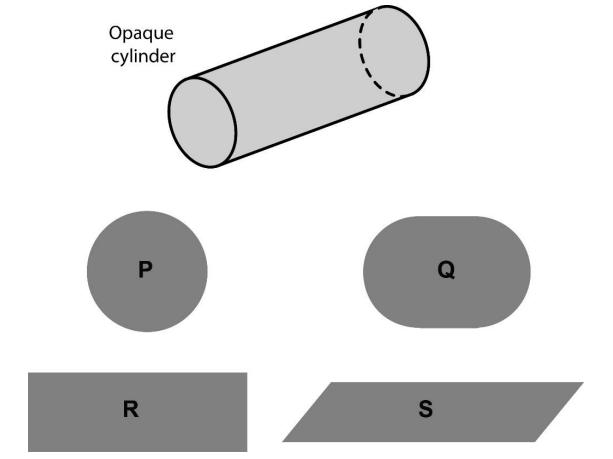
An opaque cylinder (shown below) is suspended in the path of a parallel beam of light, such that its shadow is cast on a screen oriented perpendicular to the direction of the light beam. The cylinder can be reoriented in any direction within the light beam. Under these conditions, which one of the shadows P, Q, R, and S is NOT possible?
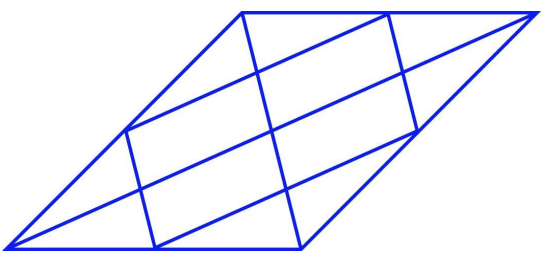
How many triangles are present in the given figure?