
A function f (x) is defined as \(f\left( x \right) = \left\{ {\begin{array}{cc} {{e^x},}&{x < 1}\\ {\ln x + a{x^2}+bx,}&{x \ge 1} \end{array}} \right.\), where x ϵ R. Which one of the following statements is TRUE?
f(x) is differentiable at x = 1 for the unique value of a and b.
Continuity at 1 requires a+b=e. Equality of one-sided derivatives requires 1+2a+b=e. Subtraction gives a=−1, then b=e+1. Therefore exactly one pair (a,b) makes the function differentiable at 1.
Important Questions from Differentiability
A differentiable function $f(x)$ is such that $f(-0.1) = 2, f(0) = 1, \text{ and } f(0.1) = 2$.
Then, $\frac{d^2f}{dx^2}$ at $x = 0$ is ______ (answer in integer).
- The differential of the equation, $x^2 + y^2 =1$, with respect to $x$ is
Suppose the function f(x) = x n, n ≠ 0 is differentiable for all x. Then n can be any element of the interval
The figure shows the distance vs time graph of a moving particle. The tangents to the curve at A and B make angles of $45^\circ$ and $60^\circ$ respectively with the time axis.
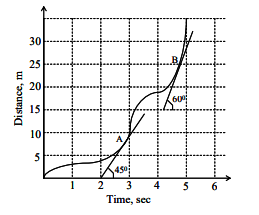
The ratio of the speeds of the particle at B and at A isDerivative of cos x with respect to x is


