
A conductor carries a current vertically downwards in a magnetic field directed southwards, It then experiences a force in the direction of:
West
Understanding the Force on a Current-Carrying Conductor
When a conductor carrying electric current is placed in a magnetic field, it experiences a force. The direction of this force depends on the direction of the current and the direction of the magnetic field. This phenomenon is governed by the principles of electromagnetism.
To determine the direction of the force, we can use Fleming's Left-Hand Rule or the vector cross product formula for the Lorentz force.
Applying Fleming's Left-Hand Rule
Fleming's Left-Hand Rule is a common mnemonic used to find the direction of the force, magnetic field, or current when the directions of the other two quantities are known. For a current-carrying conductor in a magnetic field:
- The Forefinger points in the direction of the external magnetic field (\(\vec{B}\)).
- The Middle finger points in the direction of the conventional current (\(I\)).
- The Thumb then points in the direction of the force (\(\vec{F}\)) experienced by the conductor.
These three fingers must be held mutually perpendicular to each other.
Step-by-Step Application of the Rule
Let's apply Fleming's Left-Hand Rule to the specific conditions given in the problem:
- The current is vertically downwards. So, point your left hand's middle finger straight down towards the ground.
- The magnetic field is directed southwards. While keeping your middle finger pointing down, align your left hand's forefinger to point towards the South direction.
- Now, observe the direction in which your left hand's thumb is pointing. With the middle finger pointing down and the forefinger pointing South, your thumb will be pointing towards the West direction.
Therefore, the force on the conductor is directed towards the West.
Alternative Method: Lorentz Force Formula
The magnetic force (\(\vec{F}\)) on a current-carrying conductor segment of length \(\vec{L}\) in a magnetic field \(\vec{B}\) is given by the formula:
\(\vec{F} = I(\vec{L} \times \vec{B})\)
Here, \(I\) is the current, \(\vec{L}\) is a vector in the direction of the current with a magnitude equal to the length of the conductor, and \(\vec{B}\) is the magnetic field vector. The direction of the force is given by the direction of the cross product \(\vec{L} \times \vec{B}\).
Let's define a coordinate system:
- Let North be along the +y axis. South is along the -y axis.
- Let East be along the +x axis. West is along the -x axis.
- Let Up be along the +z axis. Down be along the -z axis.
Based on the problem description:
- Current direction is downwards, so the vector \(\vec{L}\) is in the \(-\hat{k}\) direction.
- Magnetic field direction is southwards, so the vector \(\vec{B}\) is in the \(-\hat{j}\) direction.
Now, let's calculate the direction of the force using the cross product \(\vec{L} \times \vec{B}\):
\(\vec{F} \propto \vec{L} \times \vec{B} \propto (-\hat{k}) \times (-\hat{j})\)
\(\vec{F} \propto (\hat{k}) \times (\hat{j})\)
Using the standard rules for cross products of unit vectors (\(\hat{i} \times \hat{j} = \hat{k}\), \(\hat{j} \times \hat{k} = \hat{i}\), \(\hat{k} \times \hat{i} = \hat{j}\)), we know that \(\hat{k} \times \hat{j} = -\hat{i}\).
Thus, the force \(\vec{F}\) is proportional to \(-\hat{i}\). In our coordinate system, the \(-\hat{i}\) direction corresponds to the West direction.
Conclusion on Force Direction
Both Fleming's Left-Hand Rule and the Lorentz force calculation lead to the same result: the force on the conductor carrying current vertically downwards in a magnetic field directed southwards is towards the West.
| Quantity | Direction Given | Rule/Vector Result | Direction |
|---|---|---|---|
| Current (\(I\)) | Vertically Downwards | Middle Finger / \(-\hat{k}\) | Down |
| Magnetic Field (\(\vec{B}\)) | Southwards | Forefinger / \(-\hat{j}\) | South |
| Force (\(\vec{F}\)) | Resulting Direction | Thumb / \(-\hat{i}\) | West |
Revision Table: Electromagnetism Concepts
| Concept | Description | Relation |
|---|---|---|
| Current (\(I\)) | Flow of electric charge. | Conventional direction is flow of positive charge. |
| Magnetic Field (\(\vec{B}\)) | Region where magnetic forces are exerted. | Has both magnitude and direction (Vector). |
| Magnetic Force (\(\vec{F}\)) | Force on charge or current in a magnetic field. | Perpendicular to both velocity/current and magnetic field. |
| Fleming's Left-Hand Rule | Mnemonic to find the direction of force, field, or current in motors. | Thumb: Force, Forefinger: Field, Middle: Current. |
| Lorentz Force Formula | Mathematical description of magnetic force. | \(\vec{F} = q(\vec{v} \times \vec{B})\) or \(\vec{F} = I(\vec{L} \times \vec{B})\). |
Additional Information: Related Concepts
The interaction between moving charges (or currents) and magnetic fields is a fundamental principle in physics. This interaction gives rise to the magnetic force. The direction of this force is always perpendicular to both the velocity of the charge (or the direction of the current) and the direction of the magnetic field. This is why the cross product is used in the formula.
- The magnitude of the force depends on the strength of the current, the length of the conductor (or the velocity of the charge), the strength of the magnetic field, and the angle between the current/velocity vector and the magnetic field vector (\(|\vec{F}| = I|\vec{L}||\vec{B}|\sin\theta\)). The force is maximum when the current is perpendicular to the magnetic field (\(\theta = 90^\circ\)).
- Fleming's Right-Hand Rule is used for generators and determines the direction of induced current, while the Left-Hand Rule is for motors and determines the direction of force.
Understanding these directional rules is essential for studying motors, generators, and other electromagnetic devices.
Important Questions from Magnetic Force on a Current-Carrying Wire
- According to Fleming's right-hand rule, if the forefinger indicates the direction of the magnetic field and the thumb shows the direction of motion of the conductor, then the stretched middle finger will predict the direction of
A metallic rod of mass per unit length $0.5 \text{ kg m}^{-1}$ is lying horizontally on a smooth inclined plane which makes an angle of $30^\circ$ with the horizontal. The rod is not allowed to slide down by flowing a current through it when a magnetic field of induction $0.25 \text{ T}$ is acting on it, perpendicular to the inclined plane. The current flowing in the rod to keep it stationary is
A circular coil of radius R having N number of turns carries a steady current I. The magnetic induction at the centre of the coil is 0.1 tesla. If the number of turns is doubled and the radius is halved, which one of the following will be the correct value for the magnetic induction at the centre of the coil?
Consider the following image:
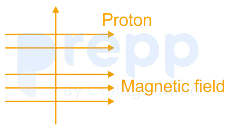
A proton enters a magnetic field at right angles to it, as shown above. The direction of force acting on the proton will be
Consider the following statements about a solenoid:
1. The magnetic field strength in a solenoid depends upon the number of turns per unit length in the solenoid
2. The magnetic field strength in a solenoid depends upon the current flowing in the wire of the solenoid
3. The magnetic field strength in a solenoid depends upon the diameter of the solenoid
Which of the statements given above are correct?


