
A clustering index is created when _______.
primary key is declared and ordered
A clustering (clustered) index decides the physical order of the rows in a table.
In common database systems, declaring a primary key automatically creates a clustered index, and the rows are stored ordered on that key.
Without any key or ordering field, there is nothing on which to cluster the data.
Hence, primary key is declared and ordered.
Similar Questions
Data which improves the performance and accessibility of the database are called :
Important Questions from Indexing
- In a relational database, a B+ Tree Index is to be constructed for a relation on a key field. In a B+ Tree, a Node Pointer points to a sub-tree and a Data Record Pointer points to a block of database records.
Let, Node size = 4096 bytes, Node Pointer size = 10 bytes, Search Key Field size = 11 bytes and Data Record Pointer size = 12 bytes.
The maximum number of Node Pointers that can be present in a non-leaf node of the B+ Tree is ________ . (Answer in integer) Consider a B+ Tree where the maximum number of key values in each leaf node is 2 and the maximum number of pointers in each non-leaf node is 3. Let the content of the B+ Tree be as shown in the figure.
Which of the following options denotes the key value(s) stored in the root node after inserting a key value 3 in the given B+ Tree?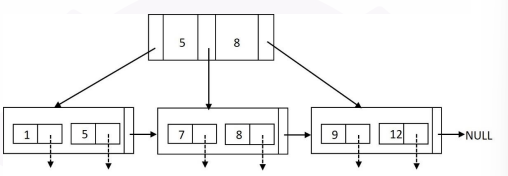
An OTT company is maintaining a large disk-based relational database of different movies with the following schema:
Movie(ID, CustomerRating)
Genre(ID, Name)
Movie_Genre(MovieID, GenreID)
Consider the following SQL query on the relation database above:
SELECT *
FROM Movie, Genre, Movie_Genre
WHERE
Movie.CustomerRating > 3.4 AND
Genre.Name = “Comedy” AND
Movie_Genre.MovieID = Movie.ID AND
Movie_Genre.GenreID = Genre.ID;
This SQL query can be sped up using which of the following indexing options?
Primary index in sequential order file organisation is also known as ______.
The total cost of retrieving records in sorted order using an unclustered B+ tree is
(P-Average number of records per data page
N-Data pages
F-Ratio of the size of a data entry to the size of a data record)



