
The problem asks for the minimum number of socks a person must pick to be absolutely sure of getting at least one pair of black socks. There are 20 black, 22 white, and 24 red socks in the box.
Applying the Pigeonhole Principle
This is a problem that can be solved using the Pigeonhole Principle, focusing on the worst-case scenario.
Worst-Case Scenario Analysis
To find the minimum number required to *guarantee* a pair of black socks, we consider the longest possible sequence of draws that *does not* result in a pair of black socks.
- The person could potentially draw all the socks that are not black first.
- Number of white socks = 22
- Number of red socks = 24
- Total non-black socks = $22 + 24 = 44$
- After drawing all 44 non-black socks, the person still has zero black socks, hence no pair of black socks.
- The subsequent socks drawn must be black, as only black socks remain. To delay forming a pair of black socks for as long as possible, the worst case is drawing just one black sock after all the non-black ones.
- Number of black socks drawn = 1
- So, the maximum number of socks drawn *without* getting a pair of black socks is the sum of all non-black socks plus one black sock: $ \text{Maximum socks without a black pair} = (\text{White socks}) + (\text{Red socks}) + (\text{1 Black sock}) $ $ \text{Maximum socks without a black pair} = 22 + 24 + 1 = 47 $
Guaranteeing the Pair
After drawing 47 socks in this worst-case sequence, the person has 1 black sock and 46 non-black socks. The very next sock drawn must guarantee the condition is met.
- The next sock drawn (the 48th sock) must be black, as there are still 19 black socks remaining in the box.
- Drawing this 48th sock will result in the person having 2 black socks, thus forming the first pair of black socks.
- Therefore, the minimum number of socks needed to guarantee at least one pair of black socks is $47 + 1 = 48$.
Important Questions from Probability (Notes)
- A stick of length L is broken into two pieces at random. What is the average length of the smaller piece?
- Two students are solving the same problem independently. If the probability that the first one solves the problem is $\frac{3}{5}$ and the probability that the second solves the problem is $\frac{4}{5}$, what is the probability that at least one of them solves the problem?
- A fair die was thrown three times and the outcome was repeatedly six. If the die is thrown again what is the probability of getting six?
A canal system is shown in the figure.
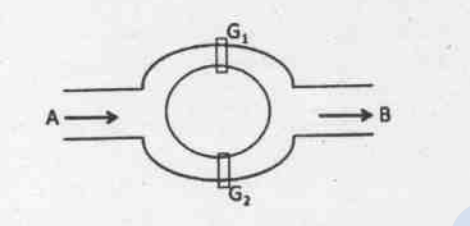
Water flows from A to B through two channels. Gates $G_1$ and $G_2$ are operated independently to regulate the flow. Probability of $G_1$ to be open is 10% while that of $G_2$ is 20%. The probability that water will flow from A to B is
- A standard fair die is rolled until some face other than 5 or 6 turns up. Let $X$ denote the face value of the last roll, and $A = \{X \text{ is even}\}$ and $B = \{X \text{ is at most 2}\}$. Then,


